

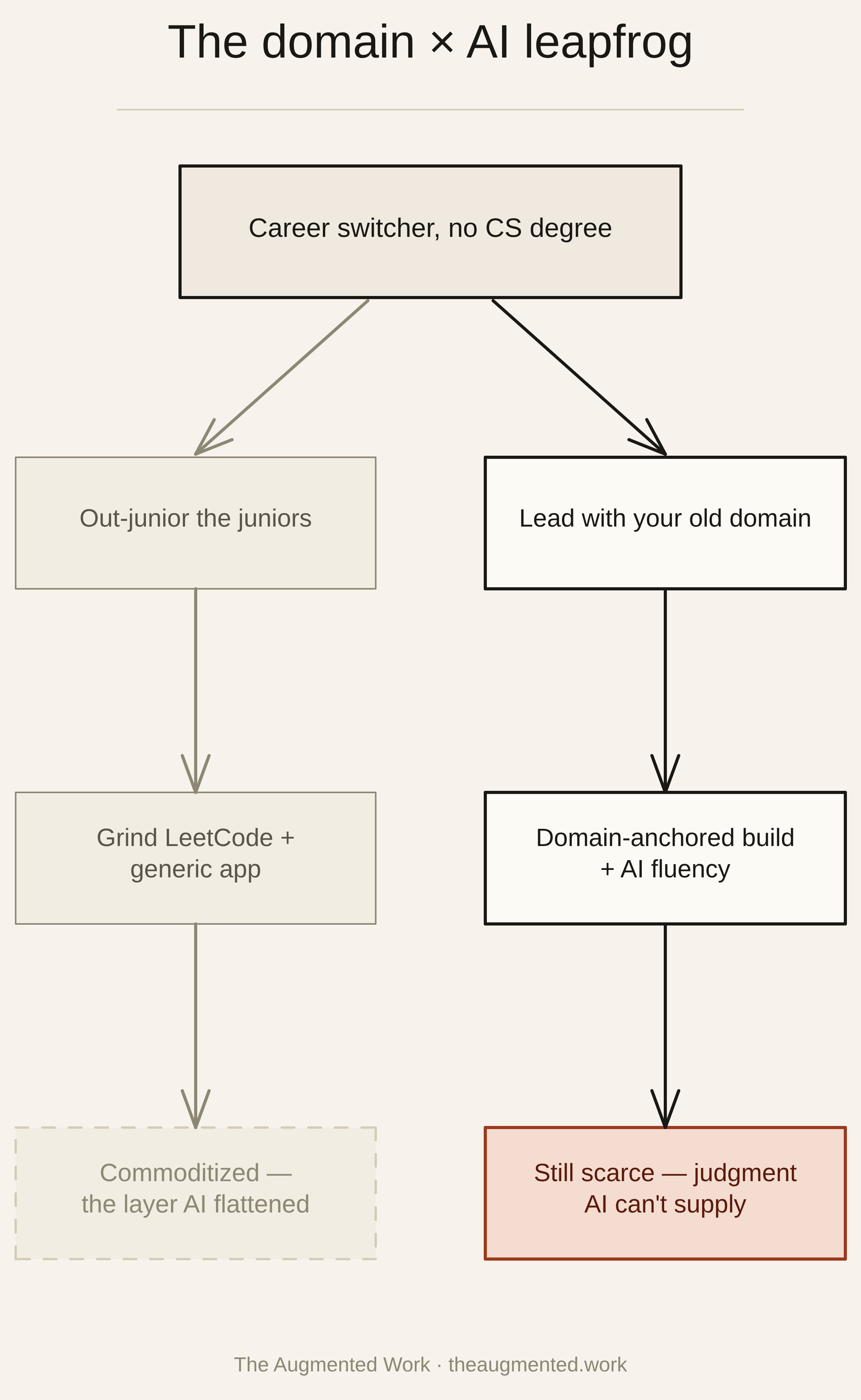
Stop trying to out-junior the juniors. The advice you’ve been handed — grind LeetCode, ship a generic to-do app, and never mention the 9 years you spent as a nurse, an accountant, or an ops lead — was written for a rung that’s collapsing. Your old career isn’t the gap on your résumé you have to apologize for. It’s the asset. Compete on context, not code.
Here’s the logic in one line: the pure-CS junior — someone who knows how to code and nothing else about any particular business — is exactly the layer AI flattened first. AI now writes the code. So the person who pairs real domain knowledge with the ability to direct and check AI doesn’t compete with that junior. They step over them.
This is for you if you’re moving into tech from a real career — nursing, accounting, operations, teaching, the trades — without a CS degree, while the entry-level door keeps narrowing. If you’re a recent CS grad or an engineer changing stacks, your situation’s different and this isn’t aimed at you.
Why the standard playbook is now the losing move
The bootcamp playbook has one goal: turn you into an interchangeable junior as fast as possible. In 2021 that worked. In 2026 it points you straight at the one rung that’s disappearing.
Look at where the hiring actually went. SignalFire’s 2025 State of Talent report found Big Tech’s new-grad hiring down 25% from 2023 and more than 50% below 2019, with new graduates now just 7% of hires — while mid- and senior-level hiring bounced back in 2024. The door at the bottom is closing; the door one floor up is the one that reopened.
It’s not only a tech-budget story. A Stanford analysis of ADP payroll data — Brynjolfsson, Chandar, and Chen’s “Canaries in the Coal Mine?” — found that employment for workers aged 22 to 25 in the most AI-exposed jobs dropped 13% since late 2022, while older, more experienced workers in those same jobs held steady or grew. Software developers and accountants were among the most affected. The roles where AI augments the work instead of replacing it didn’t see the drop.
Read those two findings together and the uncomfortable part is hard to miss: the standard playbook tells you to sprint toward the rung that’s vanishing, and to hide the experience that would make you look like the layer still getting hired. Becoming interchangeable used to be the safe move. Now it’s the one that gets you automated.
The leapfrog — domain knowledge times AI fluency
A generic junior’s whole value was being a cheap pair of hands that could turn a clear spec into working code. AI is now the cheap pair of hands. That value didn’t move — it evaporated.
You arrive with something the model can’t supply: lived context. You know what actually breaks in a hospital’s records system at 3am, why a month-end reconciliation silently fails, where a delivery route quietly loses money, which clause the lawyers always renegotiate. That knowledge took you years and a job to earn, and no amount of prompting conjures it. Pair it with AI fluency — directing the tools, reading their output skeptically, catching the wrong answer — and you’re not the junior-plus-a-bootcamp. You’re the person who can build the thing and knows whether it’s right.
That pairing is the move. Call it the domain × AI leapfrog: you don’t climb the junior ladder rung by rung, you step over it on the strength of context you already own. Learning to direct AI well is its own skill — your new job is compute allocator is the deeper version of that half.
What to build, and how to show it
Positioning is only real if you can point at something. Four steps turn your old job into a portfolio a hiring manager actually reads.
- Pick a problem you personally felt. Not a tutorial app — a specific pain from your old work. You’ll know it’s the right one when you can name the exact person who’d pay to make it go away.
- Build the smallest real thing that solves it. Domain-anchored, not a generic clone. A triage helper a nurse would trust beats a to-do list a thousand other switchers also shipped.
- Frame it as a decision, not a feature list. Don’t describe what it does — explain what you chose and why: this data model because clinics record it that way, this trade-off because that’s how the work really happens. The judgment is the signal.
- Show your verification, not just that it ran. Anyone can get an agent to produce something. The skill is proving it’s correct — the checks you ran, the edge cases you caught. Knowing how to actually confirm an agent is done is the method; bring it to your own project.
The floor you still have to clear
Here’s the honest part, because the version of this advice that skips it is doing you no favors: domain knowledge is not a hall pass past engineering fundamentals.
You still have to read code you didn’t write, reason about data, and debug something at 11pm when the stack trace makes no sense. Knowing the domain tells you what to build; it doesn’t excuse you from knowing how. If you’ve been faking your way around the basics, that gap shows the moment the work gets real — and closing the boring fundamentals you skipped is the cheapest place to start. And being fluent at prompting isn’t the same as being able to engineer — English is not the new programming language is why. Clear the floor. Then your domain edge is worth something on top of it.
The traps that sink switchers
- Don’t hide your past. It’s the most interesting thing about you as a candidate. Lead with it.
- Don’t try to out-junior the juniors. Racing a 21-year-old on LeetCode speed is competing on the one axis where you’re weakest and the market cares least.
- Don’t fake the CS you skipped. Verify instead — show you can prove correctness, not perform fluency.
- Don’t go wide too fast. Anchor in the domain you already own and go deeper before you sprawl — go wide first, then go deep is the nuance.
- Seek out interviews that put the tool in the room. Your edge — framing a messy real problem and checking the AI’s work — is invisible in a closed-book quiz and obvious the moment the tool’s allowed, which is exactly why AI should be allowed in interviews.
Where you’re starting changes the pitch
The leapfrog is the same; the one-liner you lead with isn’t.
| You’re coming from | Lead with |
|---|---|
| Clinical / healthcare | The workflow you survived — the records-system friction and triage logic engineers only guess at |
| Finance / accounting | Reconciliation, audit trails, the rules a model gets subtly wrong — and you know exactly where it’s wrong |
| Operations / logistics | The messy real-world process; you’ve felt every place a clean system meets a dirty reality |
| Teaching / trades | Tools for people like your old colleagues — a market you understand from the inside |
The bottom line
This week, pick one problem from your old job — the one you can still feel — and build the smallest real version of it. Frame it as a decision. Show how you checked the work. Then put your old career at the top of the story, not the bottom.
One thing to remember: the junior who knows nothing but code is the one being commoditized. Not you.
Sources
- 1SignalFire — State of Talent Report 2025 — Big Tech new-grad hiring down 25% from 2023 and more than 50% below 2019 (new grads now 7% of hires); demand for 2–5-year-experience talent up 27%.
- 2Brynjolfsson, Chandar & Chen — “Canaries in the Coal Mine? Six Facts about the Recent Employment Effects of Artificial Intelligence,” Stanford Digital Economy Lab (August 2025) — employment for workers aged 22–25 in the most AI-exposed jobs down 13% since late 2022 while experienced workers held steady or grew; software developers and accountants among the most affected; augmentative roles unaffected.