
In January 2023, AI researcher Andrej Karpathy posted a line that went everywhere: “The hottest new programming language is English.” It got compressed into a slogan — English is the new programming language — and a promise: if you can describe what you want, you can build it.
It’s wrong. Or more precisely, it confuses the keyboard with the craft.
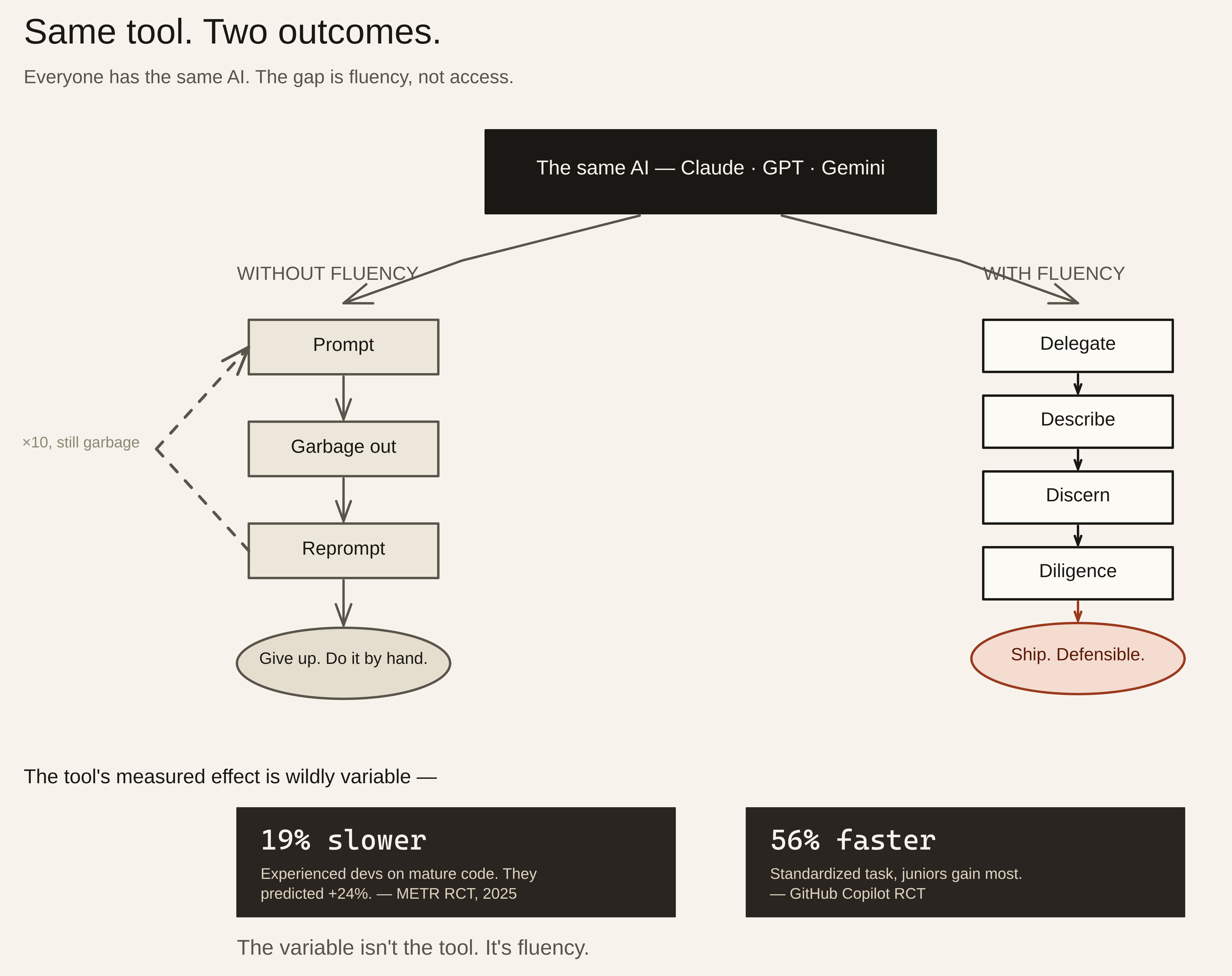
English is the medium. It is not the skill. The skill is knowing what to hand off, how to describe it, how to check the result, and who’s accountable when it ships. That skill has a name — AI fluency — and the gap between people who get real leverage from these tools and people who get garbage isn’t talent, vocabulary, or access. Everyone has the same Claude, the same GPT, the same Gemini. The difference is whether they’ve built four specific habits.
This is for you if you use AI every day and quietly suspect that “just prompt better” isn’t real advice. If you’re hunting for magic prompt templates, this isn’t that — the skill was never the words.
The proof that the tool isn’t the skill
In 2025, the research group METR ran the most rigorous trial we have: 16 experienced open-source developers, working on codebases they maintain, completing real tasks with and without AI. They predicted the AI would make them 24% faster. Measured, they were 19% slower. Same developers. Same celebrated tools. Slower.
Meanwhile, on standardized, well-documented tasks — boilerplate, a fresh web server — a controlled trial found GitHub Copilot users finished about 56% faster, with the least experienced developers gaining the most.
Read those two results together and the slogan collapses.
AI doesn’t make you faster or slower as a fixed fact. It amplifies a decision: what you point it at, and what you do with what comes back.
That decision is the craft — and it has four moves.
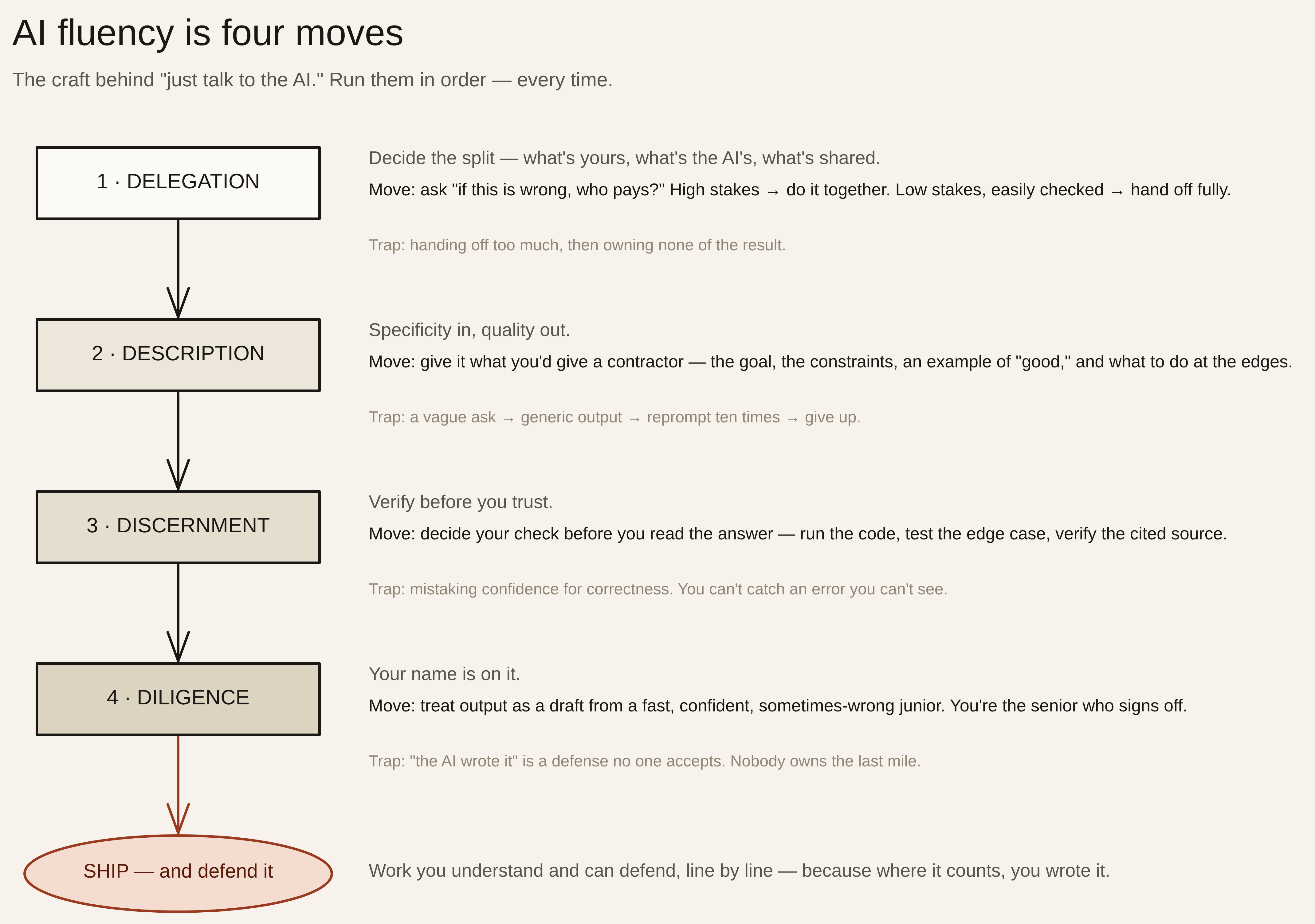
Move 01Delegation — decide what’s yours, what’s the AI’s, what’s shared
What it is. Before you prompt, decide the split. Three buckets: do it yourself, hand it fully to the AI, or do it together — you drive, it drafts.
The failure mode. Most people hand off too much, then own none of the result. They paste a vague ask, accept the first plausible answer, and ship something they couldn’t defend.
The move. For every task, ask “if this is wrong, who pays?” High stakes with your name on it → do it together, never a full hand-off. Low stakes and easily checked → delegate fully and move on. The METR slowdown is what over-delegation looks like at scale: experts let the tool drive on terrain they knew better than it did.
Move 02Description — specificity in, quality out
What it is. The quality of the output is capped by the precision of the request. It’s the oldest rule in tech leadership, and it didn’t change: if you’re not explicit about what you expect, it doesn’t get done — with people or with AI.
The failure mode. “Write me a function to clean the data” → generic output → reprompt ten times → give up and do it by hand.
The move. Give the AI what you’d give a competent contractor: the goal, the constraints (format, length, libraries, style), an example of what “good” looks like, and what to do at the edges. Front-load that context once instead of correcting it ten times. Most “the AI is useless” moments are actually under-specified requests.
Move 03Discernment — verify before you trust
What it is. Evaluation is its own skill, separate from generation. Confidence is not correctness — AI states wrong answers in exactly the same tone as right ones.
The failure mode. You can’t catch an error you don’t have the knowledge to see. This is why offloading everything is a trap: skip the work and you skip the understanding, and then you can’t tell good output from plausible-looking garbage. The leverage quietly inverts.
The move. Decide your check before you read the answer — run the code, test the edge case, verify the cited source, sanity-check the number against something you already know. If you have no way to evaluate the output, you delegated the wrong task (go back to move 1).
Move 04Diligence — your name is on it
What it is. The AI did the work, but you’re accountable for it. Ownership is the one thing you cannot delegate.
The failure mode. “The AI wrote it” is not a defense your boss, your client, or your reader will accept. Most so-called AI failures are diligence failures — nobody owned the last mile.
The move. Treat every AI output as a draft from a fast, confident, occasionally-wrong junior. You’re the senior reviewer who signs off. Before it ships, you’ve read it, you understand it, and you can defend every line as if you wrote it — because where it counts, you did.
How you know you have it
Watch someone fluent and the four moves disappear into a rhythm. They’re not fighting the tool — typing, deleting, re-prompting, sighing. They’ve stopped prompting and started operating: pointing the capability at the right target, describing it cleanly, checking it fast, owning the result. The tool becomes an extension of their judgment, not a replacement for it. That’s fluency. It looks like flow — and it’s the exact opposite of the ten-prompts-then-give-up loop.
The one thing to remember
Two pianists, one Steinway. One plays scales; one plays Rachmaninoff. The keys aren’t the skill.
English handed everyone the keyboard. What separates the output is what you do next:
- Delegate deliberately — decide what’s yours, what’s the AI’s, what’s shared.
- Describe precisely — specificity in, quality out.
- Discern ruthlessly — verify before you trust; confidence isn’t correctness.
- Take diligent ownership — your name is on it, always.
Build those four and you stop arguing about whether AI makes you faster. You just get more done — and you can defend all of it.
Sources
- 1Quote Investigator — provenance of Andrej Karpathy’s “The hottest new programming language is English” (X / Twitter, Jan 24, 2023; verified Oct 20, 2024).
- 2METR — Measuring the Impact of Early-2025 AI on Experienced Open-Source Developer Productivity (arXiv:2507.09089, Jul 2025) — experienced maintainers were ~19% slower with AI on familiar codebases despite predicting a ~24% speedup.
- 3Peng et al., Management Science (INFORMS, 2025) — The Impact of AI on Developer Productivity: Evidence from GitHub Copilot — Copilot users completed a standardized task ~56% faster; least-experienced developers gained most.