
You’ve heard it from a senior engineer, a mentor, or a viral thread: pick a niche early and go deep — that’s how you get paid. It’s the most confident career advice in tech, and for an early-career engineer in 2026, following it literally is a trap.
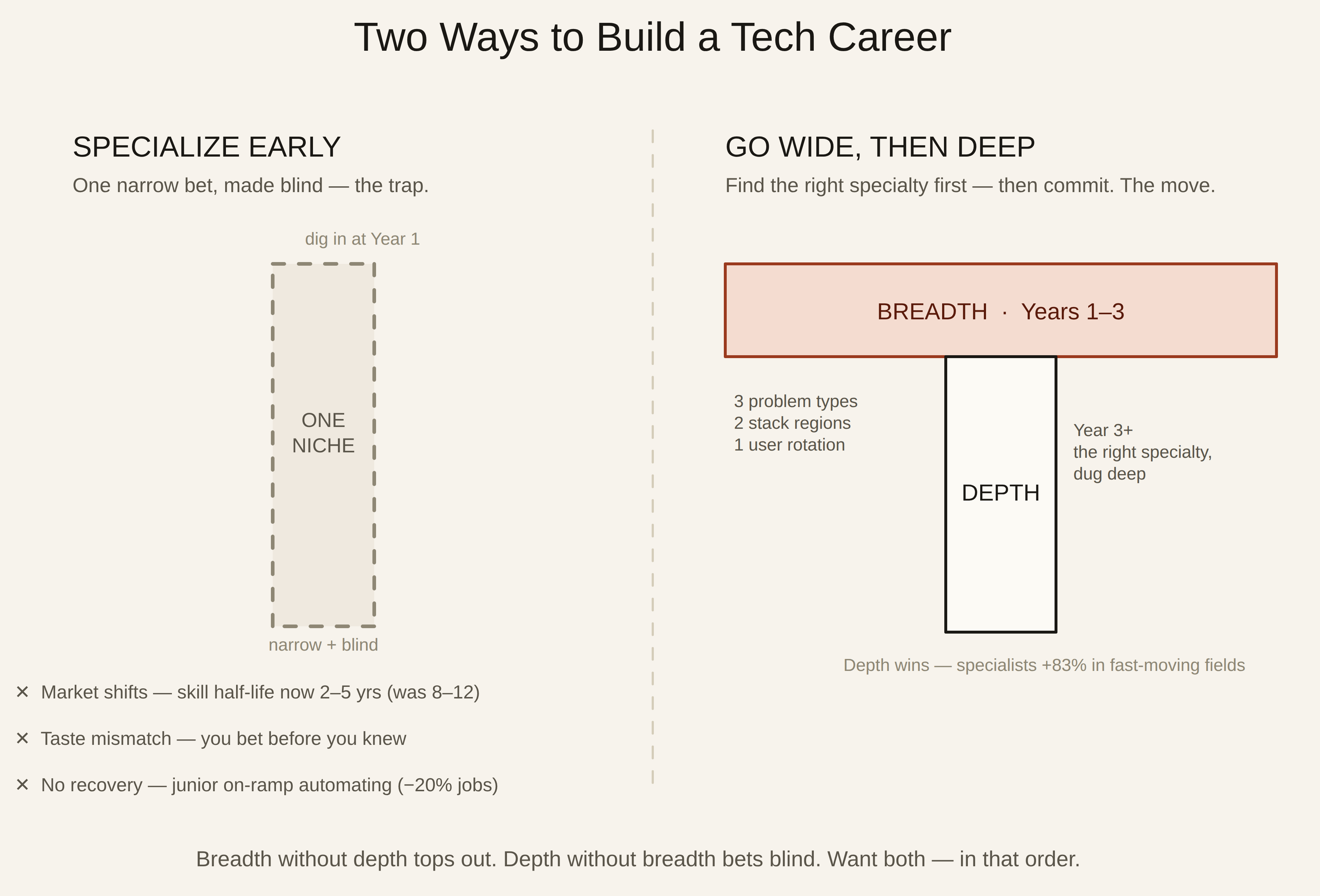
Here’s the answer you came for. The mistake isn’t specializing. It’s specializing blind, and too early. Spend your first roughly three years going wide on purpose — across problem types, across the stack, close to real users — so that when you do specialize, you pick the right thing. Then go deep, and go deep hard. Depth still wins in the end. But a wrong early bet now costs more than it did for the people giving you the advice: the junior on-ramp that used to let you recover has been automated away, and the shelf life of any single specialty has collapsed to a few years.
This is for you if you’re one to four years into a technical career and feeling pressure to declare a lane before you’ve worked in enough of them to have an opinion. If you’re a staff-level engineer who already found your corner, this isn’t aimed at you — though if you’re the one handing juniors the “specialize early” line, keep reading, because you’re probably the reason they believe it. And if you want a philosophical meditation on careers, this isn’t that either. This is a decision and a plan.
“Specialize early” is senior advice wearing a junior costume
Ask the senior who gave you the advice how they got their specialty, and the honest answer is rarely “I picked it at 22 and never looked back.” It’s usually: a few years bouncing across teams and problems, a couple of accidental projects, one that stuck — then a deep run once they knew what they liked.
What they’re handing you is the conclusion of that process, with the messy first chapter cropped out. In hindsight a career looks like a straight line to a specialty. Lived forwards, it was a search. When someone says “specialize early,” they’re describing the destination and skipping the map — and the map is the part you actually need right now.
This is survivorship bias in its purest form. The “I niched down at 22 and it worked” stories get told. The ones where the market moved, the niche died, or the person quietly came to hate the thing they’d bet on don’t get a thread.
Why a wrong early bet costs more now than it used to
This is what’s genuinely different in 2026, and why old advice doesn’t transfer cleanly. Two things changed.
The junior on-ramp got automated. The traditional way to recover from a bad specialty bet was to slide sideways into another junior role and re-learn on the job. That on-ramp is narrowing fast. AI coding tools now do the boilerplate, the routine tests, and the simple bug fixes that companies used to hire juniors to do — so a senior with an AI assistant can absorb the work instead of handing it down. The data is stark: Stanford’s Digital Economy Lab found a roughly 20% drop in employment for software developers aged 22–25 since late 2022, even as employment for older engineers in the same roles grew. Indeed’s Hiring Lab reported junior tech postings down 34% versus a 19% drop for senior roles. When you specialize wrong now, there are fewer cheap second chances to specialize again.
Specialties expire faster. Even if you bet right, the bet decays. Gartner and the World Economic Forum estimate the half-life of a technical skill has fallen to 2–5 years and as low as ~2.5 years in AI-adjacent fields, down from 8–12 years historically. A specialty you pour years into at 23 can be half-obsolete by 27. The durable asset isn’t the specific stack — it’s the learning velocity and the architectural intuition that let you re-tool when the stack moves under you. You build that by going wide, not by drilling one hole early.
Put those together and the logic flips: the more uncertain and fast-moving the field, the more valuable it is to delay the commitment until you can make it well.
“But won’t going wide make me look unfocused?”
This is the real fear at 9pm, and it’s fair. The job market does reward focus — so doesn’t a generalist resume read as “no skills”?
No, if you do it right — because going wide on purpose is not the same as drifting. Drifting is taking whatever lands on your desk and ending up with a resume that’s a list of unrelated tools. Going wide on purpose is a deliberate sweep that still tells one story: “I’m an engineer who’s seen the problem from the data side, the product side, and the user side, and here’s the kind of problem I’m now choosing to go deep on.” That’s not unfocused. That’s someone who knows why they picked their specialty — which is exactly what a wrong-bet-wary hiring market wants in 2026.
And here’s the nuance most “just specialize” advice skips: the market doesn’t reward narrowness — it rewards being right about where to be deep. More on that below.
Taste is the thing you’re actually missing
Here’s the core of it. A specialty that fits is discovered, not assigned. You cannot taste what you’ve never touched.
At one year in, you don’t yet know whether you’ll love the cold precision of distributed-systems work or find it joyless; whether messy, human, requirements-gathering problems energize you or drain you. You don’t know what bothers you — and noticing what bothers you, what you can’t stop trying to fix, is how you find the corner worth specializing in.
A specialty that fits is discovered, not assigned. You cannot taste what you’ve never touched.
That noticing is taste, and taste only comes from contact. Going wide is how you generate enough contact to develop it. Picking a niche from a thread before you have taste is just borrowing someone else’s — and theirs was calibrated to their career, in their market, at a different time.
The trap nobody warns you about: don’t let AI do your reps
There’s a new way to sabotage the wide years, and it’s specific to this moment. If you lean on AI to generate and debug everything, you go through the motions of breadth without building any.
Research from Anthropic found that developers who use AI as an autopilot rather than a tutor retain measurably less conceptual mastery — on the order of a 17% drop — and lose debugging ability, the exact skills that let you eventually run senior-level work. Going wide only works if you do the work. Use AI to explain, to compare approaches, to accelerate the boring parts — but write and debug enough yourself that the breadth actually lands in your head. Otherwise you collect job titles, not judgment.
The three ways early specialization backfires
When the “specialize early” bet goes wrong, it goes wrong in one of three ways. Each is worse in an AI-accelerated market.
| Failure mode | What it looks like | Why it’s worse now |
|---|---|---|
| The market shifts | Your niche becomes commodity work — the kind AI now does, or that the market stops paying a premium for. | Skill half-lives of 2–5 years mean the shift comes faster, often before your bet has paid off. |
| Taste mismatch | You’re good at the thing and you quietly hate it. Switching means an earnings penalty while you rebuild. | The junior on-ramp you’d switch through has shrunk, so the penalty lasts longer. |
| The ladder trap | The specialty has no senior path — it tops out, or the company only values it at a junior rate. | Fewer adjacent junior roles to climb out into once you notice the ceiling. |
The reassuring part, from labor economist Ofer Malamud’s research on early- versus late-specializing education systems: switchers take an initial earnings hit, but their wages eventually converge with everyone else’s. A wrong early bet isn’t a life sentence. But it is a detour you can usually avoid — and avoiding it is cheaper than recovering from it.
How to go wide on purpose: your first-three-years playbook
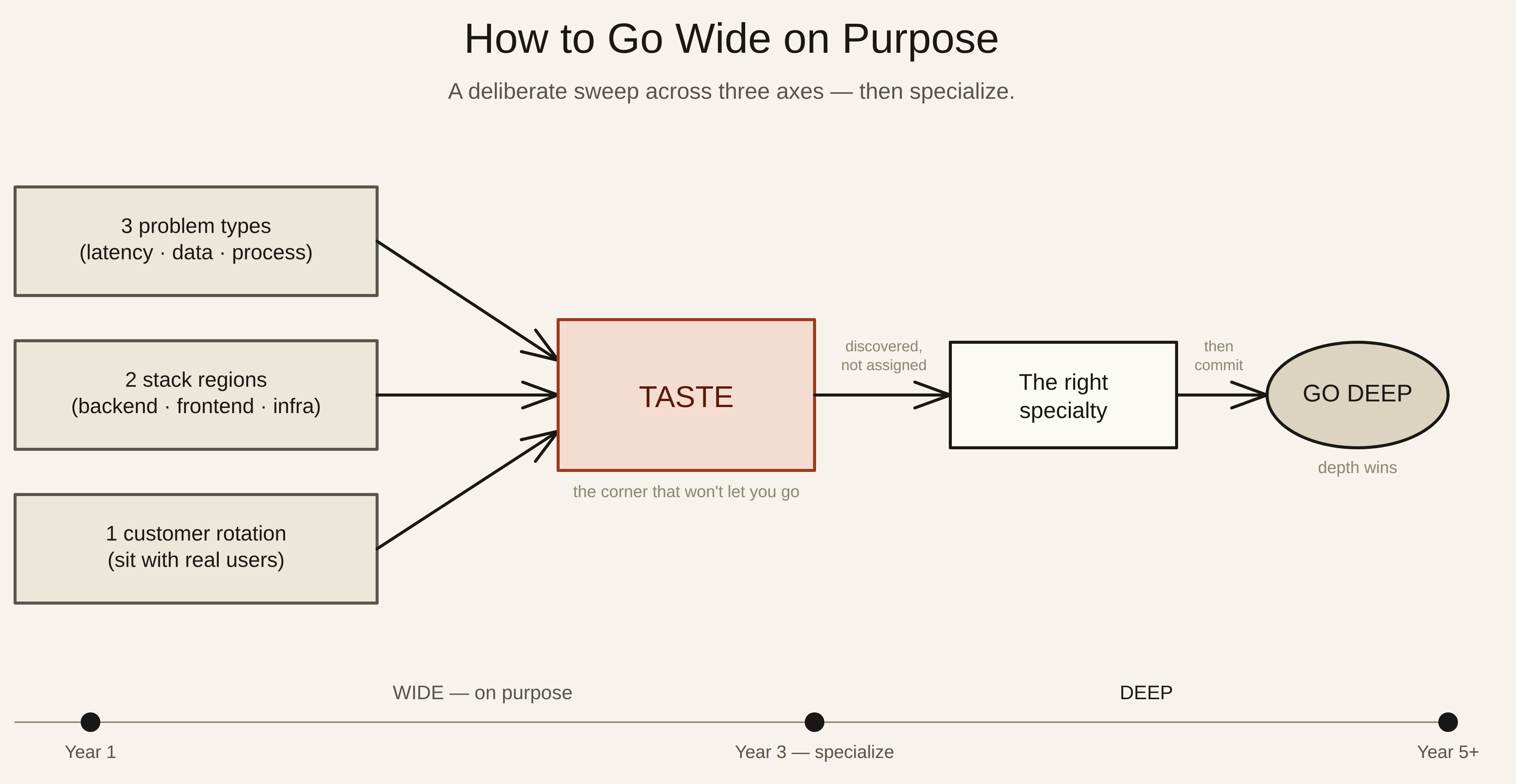
This is the part to screenshot. Going wide isn’t “say yes to everything.” It’s a deliberate sweep across three axes, ideally inside years one to three. Aim to hit each one at least once.
- Three different problem types. Not three projects in the same shape — three genuinely different kinds of hard. For example: a performance/latency problem (make the slow thing fast), a data-correctness problem (make the wrong numbers right and keep them right), and a human-process problem (turn vague, conflicting requirements into something shippable). Each one teaches you a different way of thinking — and reveals which kind of difficulty you actually enjoy.
- Two distant regions of the stack. Deliberately work somewhere far from your home turf. If you live in the backend, do a real stint in front-end or in infrastructure/ops. You’re not trying to master both — you’re learning where the seams are, how a decision in one region creates a problem in another. That cross-system intuition is the thing AI is worst at and the market pays most for.
- One customer-facing rotation. Spend real time near the people who use what you build — a support rotation, shadowing solutions engineers, sitting in on user calls. Nothing else teaches you as fast what actually matters versus what’s merely technically interesting. Most engineers never do this, which is exactly why it’s an edge.
Do this on purpose, keep a one-line note on what each experience taught you about yourself, and by year three you’ll have something most people never develop: an informed opinion about where you want to be deep.
When to actually specialize — and how hard
Going wide is a phase, not a personality. The whole point is to earn a good specialization decision, then make it. Here are the signals it’s time:
- The corner that won’t let you go. A problem type you keep gravitating back to voluntarily, even off the clock. That pull is taste talking.
- You have opinions. Things in this area bother you that don’t seem to bother others. You’ve stopped asking “how does this work” and started saying “this is done wrong.”
- The market pays for depth there. Check that your pull points at a frontier, not a commodity. AI automates commodity narrow work, but the market pays a steep premium for frontier depth — roughly 30% more for scarce specialties like AI infrastructure, MLOps, and security. And in fast-moving fields specifically, deep specialists out-produce generalists dramatically — one study found an 83% citation-weighted productivity advantage for specialists in fast-paced domains.
That last finding is the crucial counterweight: this is not an argument to stay a generalist forever. In a fast frontier, the person who goes deep wins. The argument is about sequence — go wide to find the right frontier, then go deep fast, because depth is where the payoff is. It’s the T-shaped model that McKinsey named in the 1980s and David Guest formalized in 1991: a broad base, then one deep spike. Breadth without depth tops out. Depth without breadth bets blind. You want both — in that order.
Breadth without depth tops out. Depth without breadth bets blind. You want both — in that order.
The bottom line
Don’t specialize early. Don’t refuse to specialize either. Go wide on purpose for two to three years to find the specialty that genuinely fits — then commit to it hard. The wide years aren’t a delay before your real career; they’re the search that makes the deep years pay off. The seniors telling you to skip them already did them, then forgot. In a market where wrong bets cost more and specialties expire faster, the breadth is the strategy.
The one condition that would change this: if you’ve already found, through real work, the corner that won’t let you go — and the market rewards depth there — then stop reading and go deep. Otherwise, go wide. On purpose.
Sources
- 1Brynjolfsson, Chandar & Chen, Stanford Digital Economy Lab — employment decline among software developers aged 22–25 since 2022 (2025). Reported via softwareseni.com.
- 2Indeed Hiring Lab — junior vs. senior tech posting declines (early 2025). Reported via softwareseni.com.
- 3Gartner / World Economic Forum — technical skill half-life of 2–5 years (2025), via myperformanceplus.org.
- 4Anthropic Research — over-reliance on AI and conceptual-mastery decline (2024): anthropic.com/research.
- 5BuiltIn — ~30% salary premium for scarce frontier specialties (2026): builtin.com.
- 6Teodoridis, Bikard & Vakili, “Creativity at the Knowledge Frontier,” Administrative Science Quarterly (2019): keyvanvakili.com.
- 7Ofer Malamud, NBER Working Paper 15943 — early vs. late specialization and earnings convergence (2010): nber.org.
- 8T-shaped skills — coined at McKinsey (1980s), formalized by David Guest (1991), popularized by IDEO’s Tim Brown. Background via CERI, Michigan State University (2017).