
You’re in a system design discussion, or staring at a stack trace, or reading someone else’s codebase, and a quiet voice says: they’re going to find out I don’t actually know what I’m doing. You ship the work anyway. The feeling doesn’t leave. Someone tells you “everyone feels like that, it’s just imposter syndrome” — and somehow that makes it worse, because the reassurance has never once changed how you feel on the next hard problem.
Here’s the reframe, and it’s good news disguised as bad news. For a lot of engineers, that feeling isn’t imposter syndrome at all. It’s an accurate signal that you skipped a foundation — and your nervous system noticed before your ego did. Real imposter syndrome exists and it’s a genuine clinical pattern. But it has a specific signature, and what most early-career engineers are feeling doesn’t match it. What they’re feeling is warranted — a precise, useful read on a gap they can actually close.
If that’s what’s happening, the cure was never affirmations. The cure is naming the specific fundamental you’re missing and putting in real reps to rebuild it. The discomfort is data, not a disorder. And admitting the gap is the relief, not the wound — because a gap is a thing you can fix, and a “syndrome” is a thing you’re told to live with.
This is for you if you’re early-to-mid-career, you deliver real work, and yet you feel a recurring unease in particular technical situations — the ones that touch things you never formally learned. This is not for you if your sense of fraudulence is global and evidence-proof: if you feel like a fake across every domain, no matter how much objective proof of competence piles up, that’s the actual clinical phenomenon, and the right move is a professional, not a problem set. The whole first half of this piece is about telling those two apart — so read on before you decide which one you’ve got.
Syndrome vs. signal: how to tell them apart
The reason “it’s just imposter syndrome” is bad advice is that it’s often a category error. It takes a solvable educational gap and relabels it an internal psychological failure — which sends you toward self-affirmations instead of the training that would actually fix it.
So separate the two. The clinical construct has a precise definition. Psychotherapists Pauline Clance and Suzanne Imes coined the imposter phenomenon in 1978, describing an internal experience of “intellectual phoniness” in high achievers who cannot internalize their success and chalk it up to luck, timing, or error — despite outstanding, objective evidence of their competence (Clance & Imes, 1978, Psychotherapy: Theory, Research & Practice). The defining move is that the person negates overwhelming proof they’re good. Degrees, promotions, praise — all explained away.
Later research sharpens it further: clinical imposter feelings behave like a trait, not a state. They’re global, stable, and correlated with personality dimensions like neuroticism and socially prescribed perfectionism — they follow you everywhere and persist regardless of how much you achieve (Frontiers in Psychology, 2021). That’s the tell. The real thing is evidence-proof.
A skill-gap signal is the opposite. It’s localized — it shows up in specific domains and goes quiet in the ones you’ve mastered. And it responds to evidence: when you actually learn the thing, the feeling resolves. That’s not a distortion; that’s your metacognition working correctly, telling you that you lack the domain-specific knowledge to do this particular task safely.
| Clinical imposter phenomenon | Warranted signal (a real skill gap) | |
|---|---|---|
| Where it shows up | Everywhere, across every domain | Localized to specific areas you never learned |
| What evidence does to it | Nothing — success gets explained away as luck | Resolves it — actually learning the thing quiets the doubt |
| What’s underneath | A trait-like pattern (neuroticism, perfectionism) | A real, nameable gap in knowledge or practice |
| What fixes it | Therapy, cognitive reframing | Deliberate practice — fill the gap |
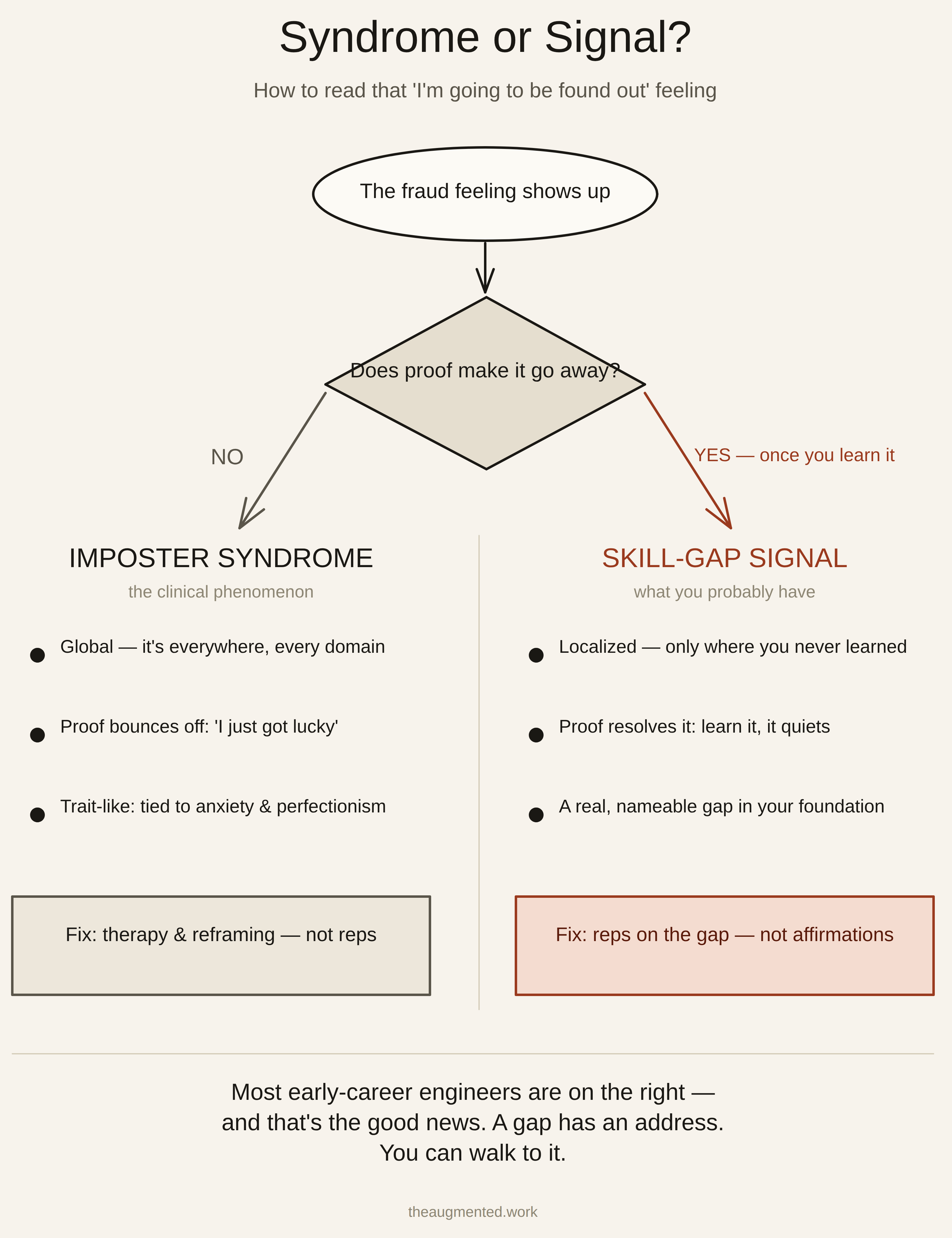
Read the table honestly against your own experience. If the feeling is everywhere and proof never touches it, take the clinical pattern seriously and treat it as one — affirmations won’t help, but a good therapist can. If the feeling is pinpointed to the topics you can already name as your weak spots, you’re not looking at a syndrome. You’re looking at a to-do list.
One aside that helps, because people reach for it: the Dunning–Kruger effect is the mathematical opposite of all this — low competence paired with inflated confidence (Frontiers in Psychology, 2021). If you’re worried you don’t know enough, that worry itself is mild evidence you’re not the clueless-but-confident case. The fact that you can feel the shape of what you’re missing is a competence, not its absence.
Don’t let a fake statistic talk you out of it
You’ve seen the line: “around 70% of people experience imposter syndrome at some point.” It gets quoted in every workshop and onboarding deck to reassure you the feeling is universal and therefore nothing to act on.
That number is folklore. Traced back, the 70% figure comes from an unpublished, unverified survey, laundered into the literature through a 2007 journalistic piece and then a 2011 review (Bravata et al. analysis, via APA, 2020). When researchers actually ran the numbers — a systematic review of 62 empirical studies — they found prevalence estimates ranging anywhere from 9% to 82%, depending entirely on how you measure it (Bravata et al., 2020). There is no clean universal baseline.
Why this matters for you specifically: the “everyone has it” stat is the exact thing that lets you keep avoiding the foundation you’re missing. If it’s universal and untreatable, why look closer? But it isn’t, and you should. The reassurance is the trap.
Why this is good news
Sit with the reframe for a second, because the relief is the whole point.
If your unease were a free-floating psychological defect, you’d be stuck managing it forever. But a localized skill gap is bounded, nameable, and closeable. It has an address. You can walk to it.
Admitting the gap is the relief, not the wound. A gap is a thing you can fix. A “syndrome” is a thing you’re told to live with.
And the discomfort itself is a sign of competence, not fraudulence. Only someone with real skill can feel the precise edge of what they don’t yet know — a true beginner doesn’t even know the gap is there. The voice saying “I don’t fully understand how this system holds state” is not the voice of an imposter. It’s the voice of an engineer who’s good enough to have noticed.
The four fundamentals to audit
When the signal is real, it almost always points at one of four foundations that are easy to skip — especially on a non-traditional path or a fast-moving team that hired you for output, not theory. Stretch into each and notice which one feels foreign, not just hard. Foreign is the gap.
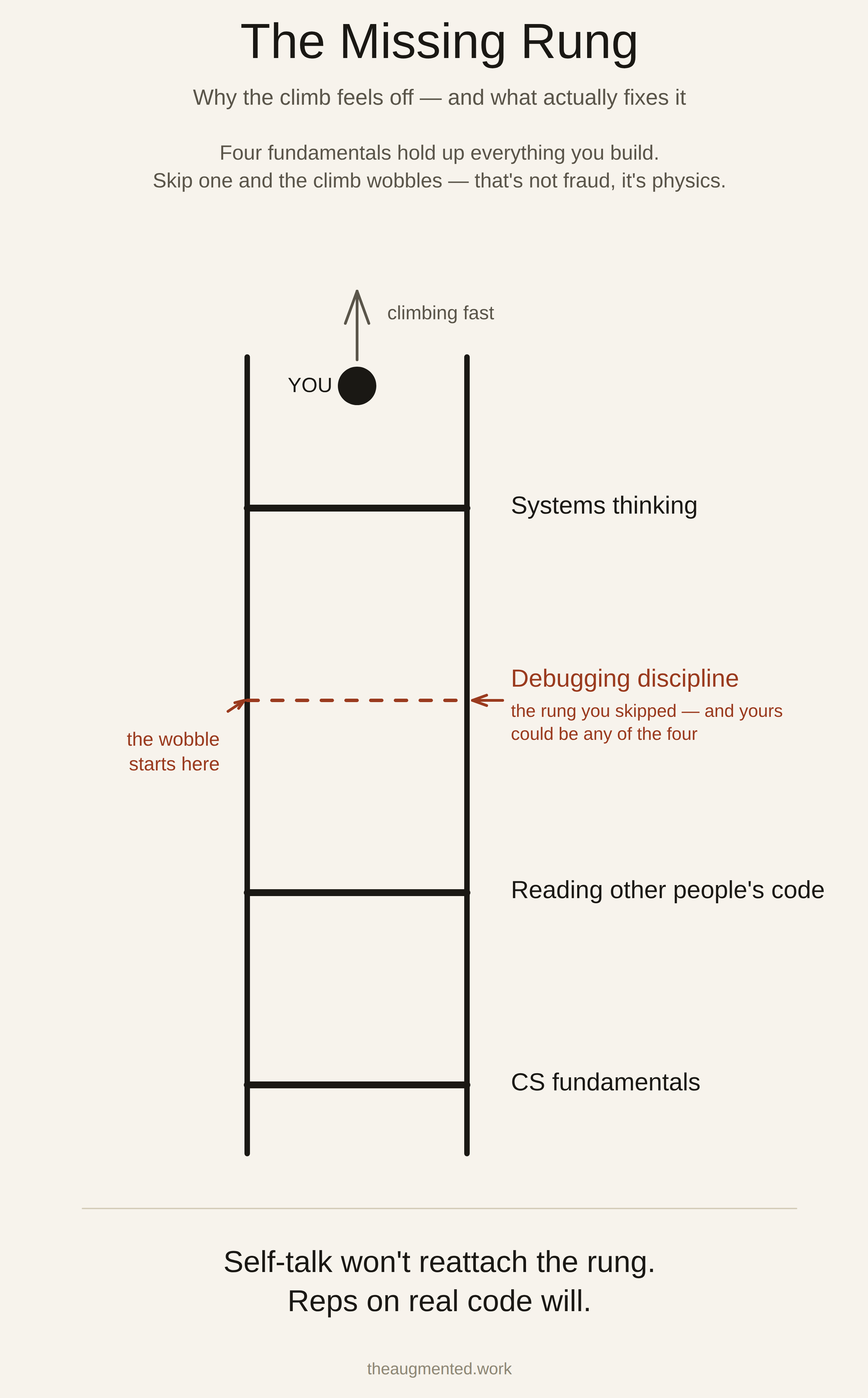
- CS basics. Data structures and algorithmic complexity — knowing why you’d reach for a hash map over a list, and being able to reason about whether something is O(n) or O(n²) before it falls over in production. The gap feels like: you can use the tools but can’t predict their cost.
- Debugging discipline. Reading a stack trace top to bottom instead of skimming for red, forming a hypothesis, and bisecting a problem methodically instead of changing things at random. The gap feels like: bugs get fixed by luck and flailing, and you dread the ones that don’t reproduce on the first try.
- Reading other people’s code. Building an accurate mental model of a system you didn’t write — following control flow, finding where a value comes from, understanding code by comprehension rather than running it and guessing. The gap feels like: someone else’s codebase is a wall, and you only feel safe in the files you authored.
- Systems thinking. Knowing where state lives, what crosses a boundary, and what happens when a piece fails — the difference between “it works on my machine” and “it works when the network is slow and the database is half down.” The gap feels like: you can build a feature but can’t say what will break it.
The honest diagnostic: find your gap
Make it concrete. For each of the four, do the smallest real version of it and watch your own reaction:
- CS basics — take a piece of your own recent code and state its time complexity out loud. Can you, without hand-waving?
- Debugging — next time something breaks, narrate your process. Are you forming hypotheses and testing them, or poking and hoping?
- Reading code — open an unfamiliar file in your own codebase and trace one function’s full path. Can you explain what it does to a colleague?
- Systems thinking — for a feature you shipped, list three ways it fails under real-world conditions. Can you get to three?
The one where you stall — where the discomfort spikes and you want to change the subject — that’s your gap. Don’t average it out or rationalize it. The discomfort is the diagnostic working. You’ve just converted a vague dread into a specific, fixable target, which is most of the battle.
How AI quietly widens the gap
A newer force makes all of this easier to hide and harder to fix: AI coding assistants. This is the part to watch if you’ve come up with Copilot, ChatGPT, or Claude in your editor from day one.
The early evidence is genuinely concerning, though still emerging. Controlled studies have started documenting cognitive offloading — delegating the planning and problem-solving to the tool instead of using it as scaffolding. In one 2025 experiment, people working complex tasks with ChatGPT scored measurably lower on cognitive engagement, showed weaker memory recall, and exhibited “metacognitive laziness” — latching onto the first generated answer and exploring fewer alternatives (Georgiou, 2025, arXiv:2507.00181). The researchers even describe a lingering “cognitive debt”: worse performance on later tasks after the tool is taken away. (Treat these as the current best evidence, not the final word — the work is recent and the field is moving fast.)
Here’s the mechanism that matters for the imposter signal. The four fundamentals above are built almost entirely during the struggle phase — the high-effort grind of reading the stack trace yourself, fixing the broken code yourself, building the mental model yourself. Inline AI autocomplete is very good at removing exactly that phase. So you ship working features while never building the foundation underneath them. The output looks senior; the foundation stays junior.
AI doesn’t quiet the fraud feeling — it earns it. You bypass the learning, the gap stays open, and the day arrives when the AI can’t solve the novel problem in front of you.
The inadequacy you feel in that moment is entirely warranted. And then, predictably, you misdiagnose it as imposter syndrome.
The rebuild: 90 days, one fundamental at a time
Pick the single gap your diagnostic surfaced. Not all four — one. Then rebuild it with the kind of practice that actually constructs skill.
The science here is specific. Expert performance is built through deliberate practice — effortful, focused work that targets a well-defined weakness at the edge of your current ability, with immediate feedback, through active generation rather than passive consumption (Ericsson, Krampe & Tesch-Römer, 1993). The operative word is active. Watching a tutorial, reading a blog, or scrolling a repo without running it does not qualify — it doesn’t engage the cognitive machinery that builds the mental model. Writing the algorithm from scratch, deliberately breaking the build, configuring the environment by hand, debugging with the test suite live — that qualifies.
So a workable shape:
- One fundamental, ~3 weeks of reps. Real code, real feedback, no passive media. If it’s debugging, that means deliberately reproducing and dissecting bugs, not watching someone else do it.
- Turn off AI autocomplete while you rebuild. The research lines up here: disable inline code generation during the learning phase so you don’t skip the struggle that builds the skill (Georgiou, 2025). Bring the AI back once the foundation is solid — as an accelerator, not a substitute.
- Rotate. Move to the next gap. Over roughly 90 days you can meaningfully rebuild two or three foundations.
One honest caveat, because overselling this would be its own failure. Deliberate practice builds specific, well-defined skills extremely well — which is exactly what these fundamentals are — but it is not a magic predictor of overall professional success. A large meta-analysis found deliberate practice explains less than 1% of performance variance in professional occupations like engineering, where the work is unpredictable and shaped by adaptable mental models and experience (Macnamara, Hambrick & Oswald, 2014, Psychological Science). The takeaway isn’t “don’t practice” — it’s that reps are how you close a concrete gap (implement the algorithm, read the trace), while the broader craft comes from building high-level structural understanding you can adapt to novel problems. Rebuild the fundamentals with reps; grow the judgment on top of them with real, varied work.
The one move
Stop calling it imposter syndrome until you’ve checked. Run the diagnostic: is the feeling global and evidence-proof, or localized to the things you never learned? If it’s global, treat it as the real clinical pattern and get real support. If it’s localized — and for most early-career engineers it is — then it was never a syndrome. It was a signal, pointing at one specific foundation you skipped.
Name that one. Spend three weeks rebuilding it with reps on real code, AI autocomplete off. Then do the next. The fraud feeling doesn’t dissolve because you finally believed in yourself. It dissolves because you finally filled the gap you’d been dancing around — and the climb stops feeling off because you stopped skipping the rung.
Sources
- 1Clance, P. R., & Imes, S. A. — The Impostor Phenomenon in High Achieving Women, Psychotherapy: Theory, Research & Practice, Vol. 15, No. 3 (Fall 1978) — the seminal clinical definition.
- 2Bravata et al., via APA (2020) — the “70%” stat is unsourced folklore; a systematic review of 62 studies found prevalence ranging 9%–82%.
- 3Frontiers in Psychology (Nov 16, 2021) — imposter phenomenon as trait-like and global vs. localized self-doubt; Dunning–Kruger as its opposite.
- 4Ericsson, K. A., Krampe, R. T., & Tesch-Römer, C. (1993) — The Role of Deliberate Practice in the Acquisition of Expert Performance — the canonical active-practice criteria.
- 5Macnamara, Hambrick & Oswald — Deliberate Practice and Performance, Psychological Science, Vol. 25, No. 8 (July 2014) — a meta-analysis of 88 studies; deliberate practice explains <1% of variance in professional occupations.
- 6Georgiou — ChatGPT produces more ‘lazy’ thinkers, arXiv:2507.00181 (July 2025, recent & partly preliminary — hold loosely) — cognitive offloading, weaker recall, and lingering “cognitive debt.”
A sourcing note: the clinical definition (Clance & Imes), the prevalence debunk (Bravata et al. via APA), the trait-like nature of the phenomenon (Frontiers 2021), and the deliberate-practice limits (Macnamara et al.) are well-attested, peer-reviewed, and pre-date this piece. The AI de-skilling evidence is recent (2025) and partly preprint — strong enough to support a clearly-hedged secondary thread, not strong enough to state as settled fact.