

Yes — learn to code. And don’t let anyone sell you the hedge on the way in.
The honest 2026 answer isn’t “yes, but differently.” That’s the line every content-farm post lands on, because it sounds wise and commits to nothing. The sharper answer is that the question is mispriced. Learning to code is worth more than it was in 2021. Learning to code for pay — to be the person who types the function — is worth less. Those aren’t a contradiction. They’re the entire answer.
Here’s why both are true at once. The floor collapsed: nobody pays a human to type what an agent emits in seconds. And the ceiling rose: judgment about what to build, and the ability to check a machine’s output, compounds harder than it ever has. Same skill. Two opposite prices.
Learning to code in 2026 is worth more than it was in 2021. Learning to code for money is worth less. Those aren’t a contradiction — they’re the whole answer.
This is for you if you’re deciding whether to start — a CS student watching the job market, a bootcamp grad mid-program, a 35- or 45-year-old eyeing a switch — and you want to know if you’ll actually get hired on the other side. If you’re a working engineer wondering whether your current job is safe, that’s a different question with a different answer, and this isn’t it. If you want a meditation on the future of work, also not here. This is a decision, made with numbers.
The question under the question
Nobody types “is it too late to learn to code” into Google at 1am because they care whether coding is “worth it” in the abstract. They want to know one thing: will I get hired? So answer that one honestly, because the honest version is uncomfortable and you’ve half-felt it already.
The entry-level door got narrower — measurably, not as a vibe. But it narrowed for one specific kind of work: the kind where your value was producing lines of code on request. If that’s the job you’re picturing when you imagine “coder,” the picture is already out of date. The door that’s closing and the door that’s opening are not the same door, and almost every panicked thread online is staring at the wrong one.
The two curves that crossed
Picture two curves. One is the payoff for producing code — being paid to turn a ticket into working syntax. The other is the payoff for directing and checking code — deciding what to build and verifying that what came back is correct. For most of the last decade they moved together: more code, more value. In the last two years they crossed.
The floor fell. By February 2025, US software-development job postings on Indeed sat at 65% of their January 2020 level — a 35% drop — while postings for all jobs ran about 10% above 2020 (Indeed Hiring Lab / FRED, via The Pragmatic Engineer). That figure is all software-dev postings, not entry-level alone — but the entry end took the worst of it. New graduates are now just 7% of hires at the 15 largest tech companies, down 25% from 2023 and more than 50% from pre-pandemic 2019 (SignalFire, State of Tech Talent 2025). Employment for software developers aged 22–25 specifically is down roughly 20% from its late-2022 peak (Stanford Digital Economy Lab, “Canaries in the Coal Mine?”).
One honest caveat the angrier threads drop: those declines aren’t proven to be AI alone. The Stanford team — whose cleanest number is a 13% relative employment drop for 22-to-25-year-olds in the most AI-exposed jobs through July 2025, revised to about 16% by October — frames AI as the most plausible driver, not a proven one; interest rates and the post-2021 tech retrenchment are real confounders. SignalFire says the same out loud: smaller funding rounds, leaner teams, fewer new-grad programs, and AI, together. The floor fell. AI is a big part of why — not the whole of it. (For what that missing bottom rung does to the people who land just above it, see why you don’t have imposter syndrome — you just skipped the boring fundamentals.)
The ceiling rose. While the typing got cheap, the work around the typing got more valuable — and the market is starting to price it. By December 2025, more than 20% of software-development postings on Indeed mentioned AI (Indeed Hiring Lab). The share of early-career postings asking for AI skills hit 4.2% by March 2026, nearly double a year earlier (Handshake, via CNBC). The competition reshaped to match: Handshake’s full-time entry-level postings fell about 15% year over year while applications per job rose roughly 30% — and software engineer, the single most-posted entry-level role for the class of 2020, fell to 9th by 2024–25 (Handshake Network Trends).
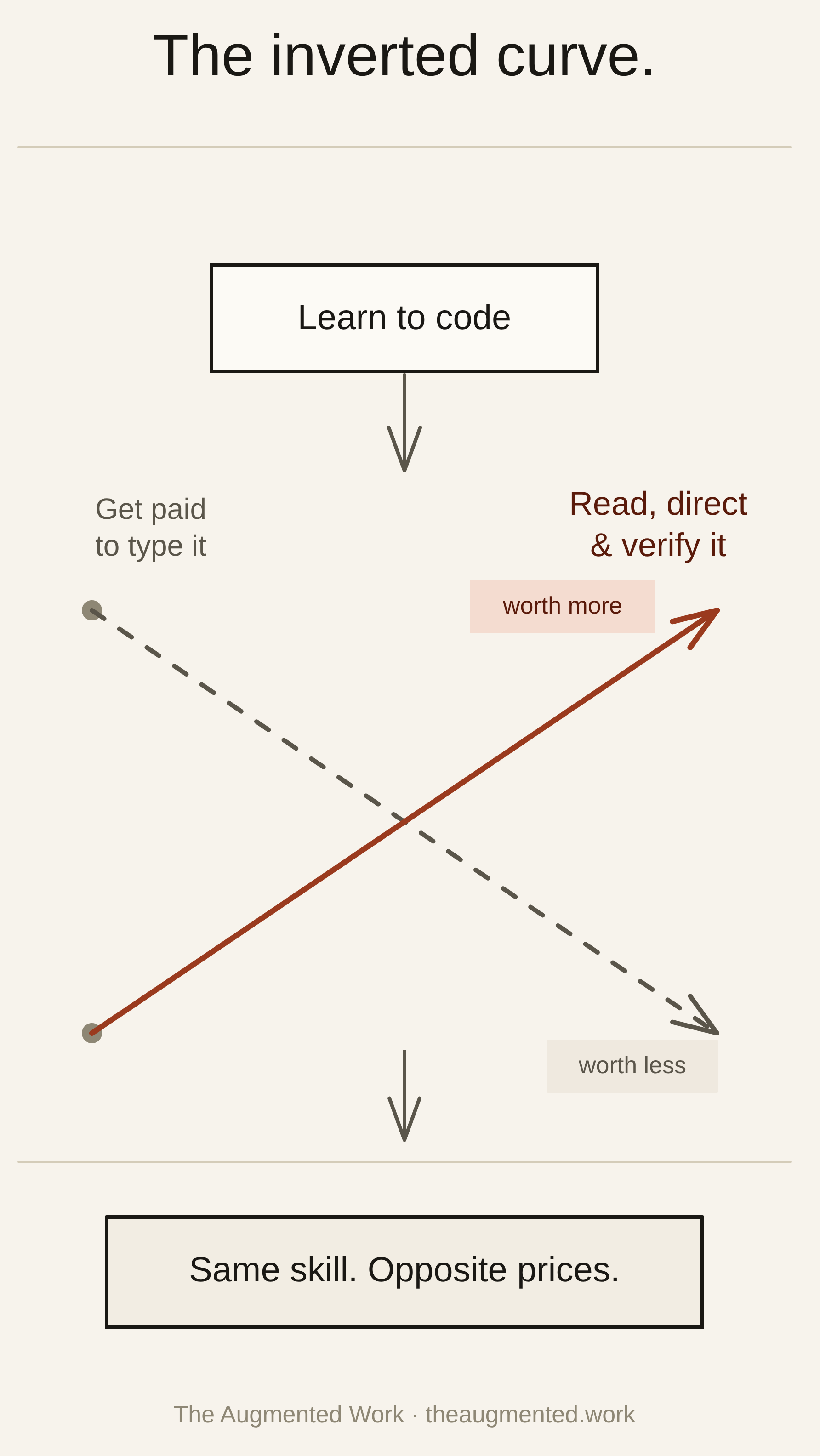
So the payoff curve didn’t shrink. It inverted. The half of the job that was scarce — producing code — got abundant. The half that was assumed — knowing what to build and confirming it’s right — got scarce. If you learn to code only to occupy the part that fell, the door is closing on you. If you learn it to occupy the part that rose, you’re walking toward the part of the market that’s actually growing.
“Learn to code” was always a proxy
Reframe the verb, because this is the move that makes the rest make sense.
“Learn to code” was never really about coding. Typing syntax was the visible surface of something underneath: thinking in systems, breaking a vague problem into parts you can actually build, debugging as reasoning instead of guessing, reading code you didn’t write and holding it in your head. We said “learn to code” because writing the code was how you were forced to learn all of that. The syntax was the toll booth; the judgment was the road.
AI removed the toll booth. It does the surface — the syntax, the boilerplate, the plausible first draft — at a speed no human will match. What it cannot do is the thing underneath. The same models that breeze through tidy, well-specified problems fall apart the moment real ambiguity shows up, and — this is the part most people get backwards — they fall apart without telling you. In the most rigorous trial we have, the research group METR had 16 experienced developers work real issues on codebases they maintain, with and without early-2025 AI tools. The developers predicted the AI would make them 24% faster. Measured, they were 19% slower — and even after finishing, they still believed it had sped them up by about 20%. (That result is scoped to expert developers on large, mature repos they know cold, using early-2025 tooling — not a universal law that “AI slows everyone down.”) Read it for what it tells you, the person deciding what to learn: the experts couldn’t feel the difference between help and harm. The skill that catches what they missed is the one that’s now scarce. The proxy died. The thing it was a proxy for got more valuable.
What’s now load-bearing: spec, verification, taste
If producing code is no longer the scarce part, three skills moved from “nice to have” to the center of the job. None of them is typing speed.
Writing the spec. When an agent does the building, your highest-value hour is the one before it builds — turning a vague ask into a brief precise enough that a fast, literal worker can’t get it wrong. That’s the whole shift from doing the work to allocating the work, covered in why your new job is compute allocator.
Verifying the output. This is the one the data screams about. In Stack Overflow’s 2025 survey, 84% of developers use or plan to use AI tools — but 66% are frustrated by “AI solutions that are almost right but not quite,” 45% say debugging AI-generated code takes more time than writing it themselves, and only 3% “highly trust” the output (Stack Overflow 2025 Developer Survey). “Almost right but not quite” is the defining texture of the work now, and catching it is a skill you can only build by understanding the code well enough to know when it’s lying to you. How to design a check the agent can’t fudge is its own piece: how to actually know when your agent is done.
Taste — knowing what’s worth building, and what good looks like. This is judgment, and it’s the part that doesn’t transfer in a prompt. The whole bundle of pointing the tool at the right target, describing it cleanly, and owning the result has a name — AI fluency — and it’s four learnable habits, not a personality trait: why English is not the new programming language.
You can already see the shift inside the companies furthest down this road. At Google, more than a quarter of new code is now generated by AI and then reviewed and accepted by engineers — Sundar Pichai’s own framing on the Q3 2024 earnings call, and worth reading with both qualifiers intact, because it’s self-reported and the “reviewed and accepted by engineers” half is the whole point. The job there didn’t disappear. It moved one seat over — from typing the line to deciding whether the line is right. That seat is exactly the one you’re deciding whether to learn your way into.
The honest verdict, by who you are
The answer isn’t one-size, so here it is split by the three people most likely to be reading this. Same verb — learn to code — but the reason, and the trap, differs.
| If you’re… | The honest verdict |
|---|---|
| A CS student / new grad | Yes — but treat the degree as the floor, not the finish line. The entry rung is thinner and more crowded (the NY Fed put recent CS-grad unemployment at 6.1% and computer engineering at 7.5%, on 2023-vintage data — directional, but not nothing). The way through isn’t out-typing the AI; it’s being the junior who can read and verify its output. Build that and you’re the cheap hire who’s actually safe. |
| A bootcamp grad / self-taught | Yes — but the thing bootcamps under-taught is now the entire game: reading unfamiliar code, debugging as reasoning, systems thinking. More frameworks won’t move you; reps on those fundamentals will. Spend them there. |
| A mid-career switcher | Yes — and your existing domain is the edge, not the handicap. You already know what’s worth building in some field; coding literacy lets you direct the machine to build it and judge whether it did. Don’t compete with 22-year-olds on raw output — compete on knowing which output matters. |
And if you’re early enough to be choosing what to go deep on, don’t lock in yet — go wide first, on purpose: why you should go wide before you go deep.
What changes Monday
Learn to code to read and direct it — not to be paid to type it. The literacy survived. The stenography died. Everything above is downstream of that one swap.
So here’s the move, concretely. Open a real repository you didn’t write — an open-source project, a teammate’s service, anything non-trivial — and practice the part the market now pays for: trace one function end to end, predict what it does before you run it, then check. When you’re learning, turn the AI autocomplete off for the struggle phase, because the struggle is where the judgment gets built; bring it back once the foundation holds. Do that for an hour a day and you’re training the exact skill the hiring data is bending toward — not the one it’s bending away from.
The people asking “is it too late to learn to code” are picturing the job that’s leaving. Learn the one that’s arriving instead. It’s the same keyboard — it’s a completely different bet.
Sources
- 1The Pragmatic Engineer — analysis of the Indeed Hiring Lab / FRED job-postings index (February 2025) — software-development postings at a five-year low: 65% of the January 2020 level (−35%) while all-jobs postings ran ~10% above 2020. Index covers all software-development postings, not entry-level only.
- 2SignalFire — State of Tech Talent Report 2025 — new grads 7% of hires at the top-15 tech firms, down 25% vs 2023 and more than 50% vs 2019. A venture-capital firm; it attributes the decline to multiple factors — funding, team size, new-grad programs, and AI — not AI alone.
- 3Brynjolfsson, Chandar & Chen — Canaries in the Coal Mine? Six Facts about the Recent Employment Effects of AI, Stanford Digital Economy Lab — software developers aged 22–25 down ~20% from their late-2022 peak; a 13% relative employment decline (through July 2025), ~16% by October, for early-career workers in the most AI-exposed jobs. Non-peer-reviewed working paper; the authors frame AI as the most plausible driver, not proven causation.
- 4Indeed Hiring Lab — January 2026 labor-market update — more than 20% of software-development postings mentioned AI (December 2025).
- 5Handshake, via CNBC (April 2026) — 4.2% of full-time early-career postings called for AI skills (March 2026), nearly double a year earlier. Distinct dataset from Indeed’s all-postings AI-mention share — do not merge.
- 6Handshake Network Trends — Class of 2025 report — full-time entry-level postings down ~15% year over year, applications per job up ~30%; software engineer fell from the most-posted entry-level role (class of 2020) to 9th by 2024–25.
- 7Federal Reserve Bank of New York — Labor Market for Recent College Graduates (ACS 2023 vintage) — recent computer-science-grad unemployment 6.1%, computer engineering 7.5%. Directional, not real-time.
- 8METR — Measuring the Impact of Early-2025 AI on Experienced Open-Source Developer Productivity (July 2025) — 16 expert developers were 19% slower with early-2025 AI tools, though they predicted 24% faster and believed afterward they were ~20% faster. Scoped to experts on large, mature repos they maintain — not a universal claim.
- 9Stack Overflow 2025 Developer Survey — 84% of developers use or plan to use AI tools; 66% frustrated by “almost right but not quite,” 45% say debugging AI-generated code takes more time, only 3% highly trust the output.
- 10Sundar Pichai — Alphabet Q3 2024 earnings remarks (official Google blog) — “more than a quarter of all new code at Google is generated by AI, then reviewed and accepted by engineers.” Self-reported and methodology-free; both qualifiers are load-bearing.