

The interviewer already assumes you used AI on the take-home. Everyone does, and they know it. So the question they’re actually asking, in every round, isn’t can you write this code? The machine can write it. It’s can I trust you to point a machine at a problem and catch it when it’s wrong?
Get that one shift and the whole loop reorganizes. Stop hiding your AI use and start showing your judgment — your process, the checks you ran, the trap you caught the model walking into. That’s the answer to the take-home, the system-design round, the salary call, and the single most-feared question of the 2026 loop: “Do you use AI?” You answer it honestly, by showing the verification habit — not by denying it, and not by groveling for using it.
This is for you if you’re a junior engineer or a career-switcher in a loop right now — the take-home is due, the system-design round is Thursday, and you’re quietly rehearsing what to say when they ask about AI. If you design and run interviews, you want the interviewer’s side of this same table instead — this is the candidate’s. And if your plan is to convince them you don’t touch AI at all, close this tab: that plan is already dead, and the next section is why.
Every round is now the same round
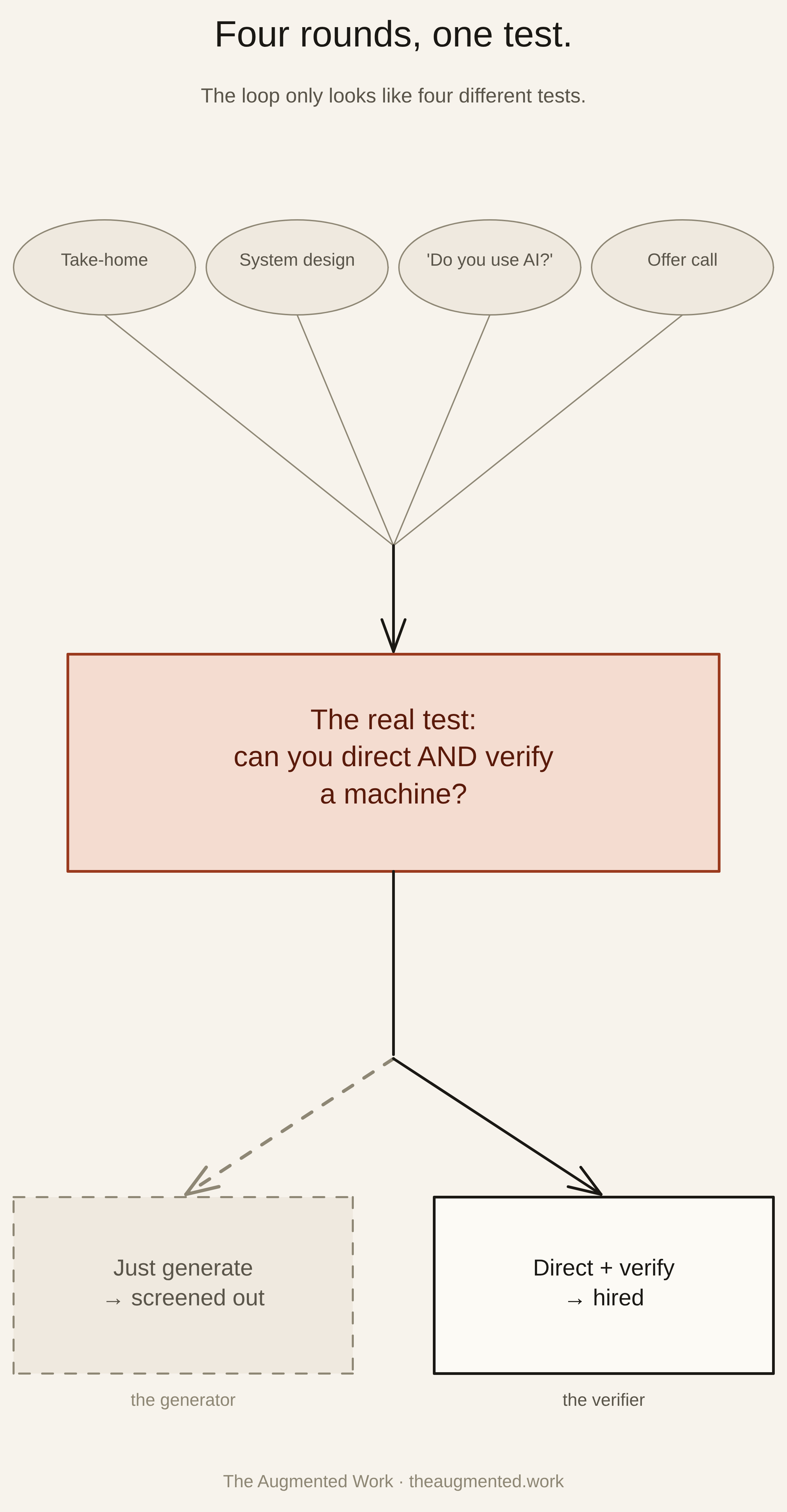
The four parts of a modern loop look different — a take-home, a live system-design session, a behavioral chat, an offer call. They’re the same round asked four ways. Each one probes a single thing: when you hand a problem to a machine, are you the person who can verify the output, or just the one who generated it?
That’s not a soft skill. It’s the actual job. The case that your new job is compute allocator is that the work has moved from doing the task to deciding what’s worth running and specifying it so an unsupervised machine can’t drift. Hiring is catching up to that shift faster than most candidates have noticed. The interviewer doesn’t need to watch you type. They need to find out whether you’ll catch the model when it’s confidently wrong — because that’s the failure mode that now costs them money and shipped bugs.
This isn’t paranoia on their part. When 75% of knowledge workers use AI at work (Microsoft) and 76% of developers are using or planning to use AI tools (Stack Overflow), and roughly 80% of candidates use an LLM on a top-of-funnel coding test even when explicitly told not to (Karat), assuming you used the tool is just the interviewer being realistic. The denial doesn’t fool anyone. It just wastes the one thing you came to show.
So read every round through one lens: am I showing them the generator, or the verifier? The generator produces output and hopes it’s right. The verifier directs the output and proves it’s right. In 2026, one of those gets screened out. The other gets the offer.
The question everyone’s afraid of: “do you use AI?”
This is the moment candidates dread most in the loop, and there’s one principle that survives every version of it: don’t fake, don’t grovel — show the verification habit. You use AI. You also check it. Lead with the checking, and the question stops being a trap.
The companies that haven’t worked this out are doing the opposite — policing. 72.4% of recruiting leaders are now dragging interviews back in-person specifically to stop AI use (Gartner, via Computerworld). You can’t control which kind of interviewer you draw. What you can control is having one honest answer that holds up no matter who’s asking. There are three types of asker, and the same principle bends to fit each:
1. The skeptic thinks reaching for AI means you can’t really do the work. Disarm them by leading with what you don’t trust it to do.
“Yes — for boilerplate, unfamiliar APIs, and a first pass. But I don’t ship what I can’t explain, so I read every line and write the test before I trust the output. Last week it handed me a confident off-by-one in a pagination loop, and I caught it because the edge-case test I’d already written went red.”
You’ve just shown them the verifier, not the generator.
2. The believer uses AI heavily themselves and wants to see range and process. Show them how you direct it.
“Constantly. The skill I’ve been building isn’t prompting — it’s knowing what to hand off and how to check what comes back. I’ll spec the task tightly, let it draft, then verify against the actual data and the edge cases it skipped.”
That’s the point that English is not the new programming language, said in an interview: the tool is the medium, the judgment is the skill.
3. The trap-setter asks it flatly, watching to see whether you’ll lie, over-claim, or panic. The trap is the binary framing — refuse it and offer to show your work.
“If you mean did I use AI on the take-home — yes, the same way I would on the job. I can walk you through exactly what I wrote myself, what I generated, and how I checked each part.”
The offer to open the hood is what defuses it. Nobody who’s hiding something volunteers the receipts.
Underneath all three: you’re not defending AI use, you’re proving you’re the kind of person who directs and verifies. The answer that wins is never the cleverest. It’s the one that demonstrates the habit.
The take-home, with AI assumed
The old move — do it yourself, maybe sneak the AI, hand back a spotless file, hope nobody asks — is dead. They assume you used the tool, and a flawless solution from a junior who then can’t explain it is a flag, not a flex. The take-home stopped being a test of whether you can produce the code. It’s a test of how you work with the machine. Three concrete moves:
- Hand back the process, not just the artifact. Add a short README or a readable commit history: what you generated, what you wrote by hand, what you changed and why. This is the compute-allocator move — you’re the one who decided and specced, so make that visible.
- Verify in the open. Include the tests you ran, the edge case you found the model skipping, the one thing you refused to ship because you couldn’t explain it. A glanceable proof-of-work artifact — the kind that verifying an agent’s work calls the cheapest honest check — tells a reviewer in seconds that you checked, instead of asking them to take your word.
- Leave your fingerprints on a judgment call. Drop a comment where you overrode what the model wanted to do — “the obvious approach reprocesses the whole list on every insert; went with X instead.” That single note is the signal: you understood the code, you didn’t just accept it.
A reviewer can see exactly where you aimed the tool and where you caught it.
A perfect solution that falls apart the moment they ask you to defend one line of it in the follow-up.
System design: the round AI helps least
Here’s the round where, live and watched, the tool helps you the least — and that’s precisely why it’s become the differentiator. You can’t quietly prompt your way through “design a rate limiter for our API” while someone asks you why you chose a sliding window over a token bucket. The reframe still holds — they’re testing judgment — but here the judgment has to be yours, out loud, with no autocomplete to lean on.
So this is where skipped fundamentals show. If your sense of unease spikes the moment a whiteboard appears, that’s usually a sign you skipped the boring fundamentals, not imposter syndrome — a fixable gap, not a verdict on you. And it’s where having gone wide pays off: you can only weigh tradeoffs across consistency, latency, and cost if you’ve actually worked on enough different systems to have an opinion, which is the whole argument for going wide before you go deep.
Run it the durable way: think out loud, name the tradeoffs, state your assumptions, ask the clarifying question before you draw a box. Then expect the new closer — “how would you bring AI into this design?” Have a real answer: where you’d let an agent run unattended, where you’d never, and what you’d verify before trusting either. That question is the reframe wearing a different hat, and a candidate who’s ready for it stands out immediately.
“AI-fluent” is the floor, not the ceiling
Quick one, because it changes how you negotiate. “AI-fluent” is now table stakes. Saying “I use AI well” anchors you at the floor, because everyone in the pipeline can say the same thing — they all have the same Claude, the same GPT, the same Copilot. Tool fluency is no longer a differentiator; it’s the price of entry.
The premium is for the verifier — the person trusted to point an expensive, unattended run at a problem and catch it when it comes back confidently wrong. So when the offer call comes, anchor on judgment evidence, not tool talk: the trap you caught before it shipped, the bad output you killed, the call you made that held up under load. That’s the scarce thing, and scarce is what gets paid above the band.
What changes Monday
Stop drilling LeetCode patterns and prepare one thing instead: your judgment story. A 60-second, true account of a real task where you aimed a machine at a problem, caught it being confidently wrong, and shipped something correct anyway. The exact bug. How you caught it. What you’d verify before shipping. That one story answers “do you use AI?”, carries the take-home debrief, and seeds the salary call — it’s the single most reusable thing you can walk in with.
Write it tonight, before your next round. The candidates who get hired in 2026 aren’t the ones who hid the tool best. They’re the ones who can prove, in one concrete story, that they catch it when it’s wrong.
Sources
- 1Microsoft & LinkedIn — 2024 Work Trend Index Annual Report (May 8, 2024) — AI adoption among knowledge workers: 75% usage.
- 2Stack Overflow — 2024 Developer Survey, 60,000+ respondents (July 22, 2024) — 76% of developers using or planning to use AI tools.
- 3Karat (March 25, 2025) — roughly 80% of candidates use an LLM during top-of-funnel coding assessments despite instructions not to.
- 4Gartner, via Computerworld (August 26, 2025) — 72.4% of recruiting leaders returning to in-person interviews; Google, Cisco, and McKinsey reinstating physical rounds.