

Forward deployed engineer is one of the fastest-growing titles in software, and it confuses people for a good reason: it looks exactly like consulting. You embed with a customer, you fly to their office, you untangle their mess.
The difference is what you hand back. A consultant hands back a recommendation. A forward deployed engineer — FDE for short — hands back working software, running in the customer’s own systems, written by the company that makes the product. That one difference changes the pay, the skills, and whether you’ll enjoy the job.
This is for you if you’re an engineer — or switching into engineering — weighing an FDE offer, or wondering whether “forward deployed” on a job post is a real career or a polite way to say “a consultant who codes.” If you want to go deep on one system for five years, or you’d rather never sit across from a customer, you can stop here. The role isn’t built for you, and that’s the honest read.
Where the title comes from
The role started at Palantir in the early 2010s, where these engineers were known internally as “Deltas” (The Pragmatic Engineer). Palantir’s early customers were intelligence and government agencies who often couldn’t spell out what they needed — so instead of gathering requirements and handing off a build, Palantir put engineers inside the customer’s environment to learn the problem by solving it in real time.
Palantir’s own description is the cleanest definition you’ll find. A forward deployed software engineer is “a software engineer who embeds directly with our customers to configure Palantir’s existing software platforms to solve their toughest problems” (Palantir). The company frames the contrast with a regular developer in one line: a developer builds one capability for many customers; an FDE builds many capabilities for one customer.
That’s the whole idea. Most engineers make a product more general. An FDE makes it land for a specific, demanding customer — and the patterns they discover on-site get handed back to headquarters, which generalizes them into the core product for everyone else.
Why it’s suddenly everywhere
For a decade this was mostly a Palantir thing. Then generative AI created a gap that the title fills perfectly.
A frontier model is powerful and almost never useful on day one inside a real company. The data is messy, the workflows are undocumented, the integrations don’t exist, and nobody on the customer’s side knows what “good” looks like yet. Selling the model isn’t enough — someone has to build the last mile.
The venture firm a16z named this directly, calling the FDE “the hottest job in startups” and putting the problem in plain terms: “enterprises buying AI are like your grandma getting an iPhone: they want to use it, but they need you to set it up” (a16z). When the software is meant to do the work rather than assist it, a download and a login don’t get you there.
So the labs built FDE teams. OpenAI stood up a dedicated forward deployed group in early 2025 that grew from 2 engineers to more than 10 across eight cities, and now hires FDEs to “lead complex end-to-end deployments of frontier models in production alongside our most strategic customers” (The Pragmatic Engineer). Anthropic runs the same function under “Forward Deployed Engineer, Applied AI,” embedding with strategic customers to ship MCP servers, sub-agents, and agent skills into production workflows (Anthropic). (MCP — the Model Context Protocol — is the standard that lets an AI agent plug into a company’s real tools and data.) Startups followed: Y Combinator’s job board is full of “forward deployed engineer” listings.
The demand numbers are real, not vibes. One labor-data firm found FDE postings grew more than 800% between January and September 2025, and about 1,165% year-over-year (Business Insider). An independent analysis of 1,000 separate postings landed on the same 1,165% figure (Bloomberry) — two different datasets agreeing is about as solid as job-market data gets.
What the job actually is
Day to day, an FDE embeds with a customer and builds the “last mile” of the product so it runs in that customer’s production environment — writing and debugging real code on-site, then feeding what they learn back to the product team (First Round). First Round, which has hired for the role across many startups, describes the best ones bluntly: “compulsive builders.”
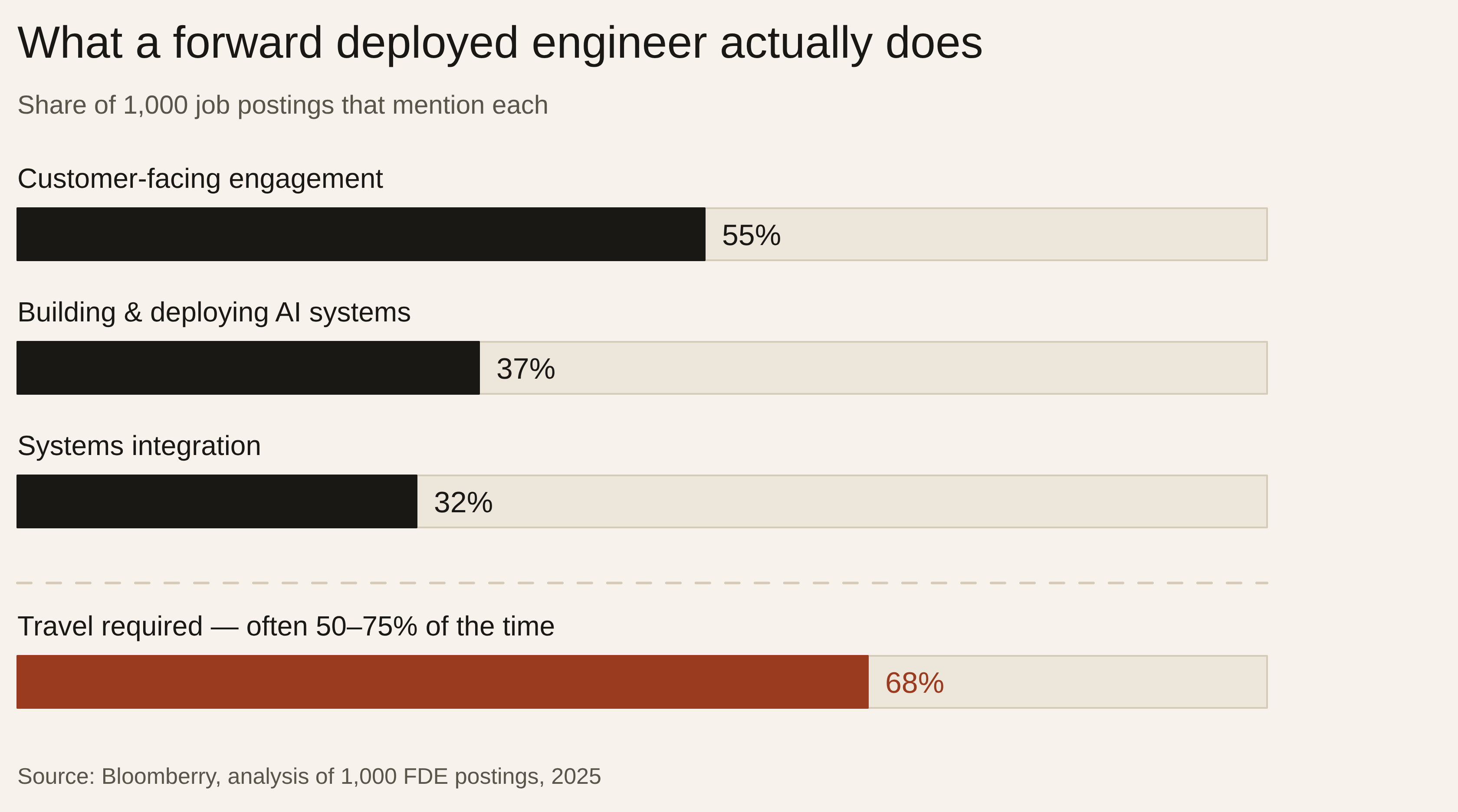
That analysis of 1,000 FDE postings gives you the concrete shape of the work (Bloomberry):
- Customer-facing engagement shows up in 55% of postings; building and deploying AI systems in 37%; systems integration in 32%.
- Zero postings mention a sales quota. You’re measured on whether the thing works in production, not on revenue you closed.
- The stack skews Python (66%) and TypeScript (35%), on AWS (32%), with AI agents (35%) and LLMs (31%) common.
- 60% want 3–5 years of experience. And 68% of roles require travel — often 50–75% of the time.
Read that last bullet twice. The travel is not a footnote; it’s the job. An FDE is part software engineer, part solutions engineer, part consultant, and the customer is in the room.
Is it just consulting rebranded?
Mostly honest answer: it rhymes with consulting, and pretending otherwise is a recruiting trick. It’s embedded, customer-facing, services-heavy, and travel-heavy. First Round calls it “definitionally an upmarket motion” — reserved for your biggest, most demanding customers — and warns about the same scope creep and endless iteration that haunt any consulting engagement. About 22% of FDEs even come from solutions-engineering backgrounds.
Here’s the part that’s genuinely different, and it’s the part that matters:
| Strategy / management consultant | Sales / solutions engineer | Forward deployed engineer | |
|---|---|---|---|
| What you hand back | A recommendation, a deck | A demo, a proof-of-concept | Production software, in the customer’s stack |
| Who you work for | A neutral consultancy | The vendor (pre-sale) | The vendor (post-sale) |
| How you’re measured | The advice landed | The deal closed | The deployment works |
| Where the work goes after | The client decides | Handed to the FDE / CS team | Fed back to the product roadmap |
Three things fall out of that table.
You ship code, not slides. “Unlike traditional solutions consultants or sales engineers, FDEs are actual software engineers who write and debug production code” (First Round).
You work for the company that makes the product — so your incentive isn’t billable hours, it’s whether the customer keeps using the thing. a16z explicitly advises forward deployed teams not to carry quotas and to sell their services close to cost, because the point is durable adoption and lock-in, not services margin.
And your work doesn’t die at the end of the engagement. The custom code you write for one customer becomes evidence for what the core product should do next. You’re a one-person feedback loop between the field and the roadmap — something a consultant, by design, never is.
Not just consulting. Consulting’s structure, with an engineer’s deliverable and a product company’s incentives.
What it pays
This is where you should be skeptical of round numbers floating around online, so here’s only what traces to a real source.
- Palantir forward deployed software engineers report a median total compensation of about $211,000, ranging from roughly $171,000 to $295,000+ (levels.fyi).
- Anthropic’s FDE posting lists a base band of $200,000–$300,000, with equity on top (Anthropic).
- At the frontier labs more broadly, engineering pay is equity-heavy and large — OpenAI software-engineer total compensation runs from about $338,000 at the junior level to over $1.2M at senior levels (levels.fyi) — though that’s the general engineering ladder, not an FDE-specific figure, which the top labs don’t publish cleanly.
The honest summary: this is paid like product engineering, not like a support or services role. The very high FDE-specific numbers you’ll see quoted on career blogs aren’t traceable to a primary source — treat them as rumor until a company posts a band.
Should you become one?
Strong yes if you recognize yourself here. First Round’s hiring pattern points at a specific profile: deep technical ability (these are people who could be staff engineers elsewhere, and they merge to production), real grit (“forward deployed engineering is painful… these folks really need to believe they can do the impossible”), the compulsive-building instinct, genuine curiosity about how a customer’s business actually runs, and comfort working in an undefined problem with no playbook (First Round).
Honest no if you’re the opposite. First Round names it directly: engineers who spent 10-plus years inside one big tech company were in the “no fly zone” — too specialized, too attached to a fixed playbook for a role that rewards range. It’s the same tension behind whether to specialize early: if you want to master one system, dislike customer contact, or can’t do heavy travel, this will grind you down no matter how good the pay is.
If you’re early in your career or switching in, the common path is straightforward: most FDEs come up through software engineering (about 45% went Software Engineer → Senior → FDE), with solutions engineering the next most common on-ramp (Bloomberry). You don’t need a special degree. You need to be able to build something real, fast, in a stack you’ve never seen, while a customer watches.
The one thing to remember
The market is paying a premium for a specific, hard-to-fake combination: an engineer who can build and sit with a customer and turn a vague problem into working software by the end of the week. That’s the skill, and it’s getting more valuable as more software is sold on the promise of doing the work rather than assisting it.
If you want to test the fit before you commit, do the FDE job for a week without the title: find someone using a tool badly, sit with them, and build the missing last mile that makes it actually work for them. If that week was the best part of your month, you have your answer. If it was the worst, you also have your answer — and you saved yourself a lot of flights.
Sources
- 1The Pragmatic Engineer — Forward Deployed Engineers (Aug 2025) — Palantir origin, the “Deltas” name, and the OpenAI FDE team.
- 2Palantir — A Day in the Life of a Palantir Forward Deployed Software Engineer (Nov 2020) — the role definition and the “one capability vs many capabilities” framing.
- 3a16z — Trading Margin for Moat: Why the Forward Deployed Engineer Is the Hottest Job in Startups (Jun 2025) — the GTM thesis and the “grandma’s iPhone” line.
- 4Anthropic — Forward Deployed Engineer, Applied AI (job posting) — the role’s work and the $200,000–$300,000 base band.
- 5First Round Review — So You Want to Hire a Forward Deployed Engineer — day-to-day, “compulsive builders,” and the fit profile.
- 6Bloomberry — I Analyzed 1,000 Forward Deployed Engineer Jobs (Nov 2025) — the work composition, travel, and the 1,165% demand figure.
- 7Business Insider (via AOL, 2025) — FDE postings up ~800% (Jan–Sep 2025) and ~1,165% year-over-year, per Live Data Technologies.
- 8levels.fyi — Palantir Forward Deployed Software Engineer compensation; and OpenAI Software Engineer compensation.