

Naval Ravikant sits down with one of the most capable AI systems on earth, and he does the one thing the entire internet has spent three years telling him not to do: nothing special.
No carefully tuned system prompt. No role-play framing. No “act as a senior staff engineer with 20 years of experience.” He just talks. In his own words, he doesn’t think “it’s worth learning tips and tricks of how to work with these AIs.” He says he’ll “just sit there stupidly talking to the computer because I know that this thing is now at the stage where it is going to adapt to me faster than I can adapt to it” (nav.al/ai).
Read that again, because it’s the whole argument in one breath. He isn’t being lazy, and he isn’t behind. He’s made a bet about where the value is going to be — and he’s refusing to spend his attention on the part of the work that the next model release is about to delete.
If you’ve got a folder of saved prompts, a bookmarked “100 prompts that will 10x your output” thread, and a quiet worry that everyone else has figured out some incantation you haven’t — this is for you. Not because you’re doing something dumb. Because you’re being diligent about the wrong half, and nobody’s told you which half.
The belief almost everyone is acting on
Here’s the belief, stated as generously as it deserves, because a lot of smart people hold it.
The models are powerful but finicky. The difference between a useless answer and a brilliant one is in how you ask. So the edge — the thing that separates the people who get real work out of these tools from the people who get slop — is prompt skill. Learn the framings. Collect the templates. Know which magic words trigger which behavior. The person with the best library of prompts wins, the same way the person who memorized the most keyboard shortcuts used to look like a wizard.
It’s a reasonable belief. It was even true for a while. In early 2023, getting a model to reason well genuinely required tricks — you had to coax it. And the market priced that skill like it was permanent: Anthropic posted a “Prompt Engineer and Librarian” role with a base salary listed up to $335,000, and the headlines treated prompt engineering as the hot new six-figure career you could land without writing a line of code (Fortune, March 2023).
So if you’ve been treating prompt skill as the thing to accumulate, you were responding rationally to a real signal. The problem isn’t that you misread 2023. It’s that the signal already changed, and the behavior didn’t.
The crack: the thing you’re hoarding has an expiry date
Watch what happened to that $335,000 job.
By spring 2025, Indeed searches for “prompt engineer” — which had spiked to 144 per million right after ChatGPT launched — had plateaued back down to 20 to 30 per million. Microsoft’s work-trends survey put “Prompt Engineer” near the bottom of the roles companies planned to add. Microsoft’s own Jared Spataro said the quiet part plainly: “you don’t have to have the perfect prompt anymore.” And companies like Nationwide stopped treating prompt engineering as a job title at all, reclassifying it as “a capability within a job title” (Salesforce Ben, May 2025).
Two years. That’s the half-life of the hottest skill in tech. Not because people got worse at it — because the models got better, and a better model is the thing that quietly deletes your technique while you sleep.
This is the part nobody warns you about when you start your prompt collection. You’re not building up a craft the way a carpenter builds up skill with a chisel. You’re memorizing the quirks of this specific model, this specific month — and the company that ships the model is, on a release cadence you don’t control, actively erasing the quirks you studied.
The turn
So here’s the uncomfortable version, the one that should make you put the prompt folder down for a second.
Getting good at prompt tricks is, for most of what’s in that folder, negative-yield work. You are spending real study hours to get better at operating a thing whose maker is committed to making your skill unnecessary. Every release that lands marks down the asset you’ve been accumulating. You’re not falling behind because you haven’t learned enough incantations. You’re running on a treadmill the vendor speeds up every few months, and calling it progress because you’re sweating.
Naval’s “laziness” isn’t laziness. It’s a refusal to invest in a depreciating asset. He’d rather sit and ramble at the machine and let it adapt — because he’s noticed the same thing the market just repriced: the tricks expire “in weeks, perhaps months at best” (nav.al/ai), and the model is climbing toward him faster than he could ever climb toward it.
The meta-skill — the actual thing worth getting good at — is not mastering the incantations. It’s telling, in advance, which of your effort is going to compound and which the next release is going to delete. Almost nobody is practicing that.
Proof one: the tricks really do get deleted — here’s one disappearing in real time
If this still sounds like a vibe, watch a concrete trick die.
For two years, the single most-taught prompt technique was “chain of thought” — you’d append “let’s think step by step” to coax the model into reasoning through a problem instead of blurting an answer. It worked. It was in every guide. It was the canonical example of prompt skill mattering.
Then the reasoning models shipped. OpenAI’s o1/o3 series and Anthropic’s Claude 3.5 and up build step-by-step reasoning in as a native component — you get the structured reasoning “without having to prompt for them explicitly.” Worse for the technique: on these models, too much prompting can hurt. As one technical guide puts it, with the reasoning-native models “explicit CoT prompting is largely redundant and may even degrade performance” because the model overthinks — and it points to 2025 research literally titled around the decreasing value of chain of thought (Vellum).
Sit with that. The most famous prompt trick in the world didn’t just stop helping. On the current models it can make your answer worse. The hours you spent perfecting your step-by-step framing weren’t banked — they were rented, and the lease is up. That’s not a one-off. That’s the pattern. The model absorbs the trick, the trick becomes the default, and the person whose edge was the trick is back to even.
Proof two: the discipline itself got quietly absorbed
Zoom out from one trick to the whole job, and you see the same thing at a larger scale — and this is the nuance that actually proves the point rather than weakening it.
“Prompt engineering” as a standalone title is fading. But the skills inside it didn’t vanish into nothing; they got absorbed into ordinary roles — AI engineer, applied ML engineer, the normal work of anyone using these tools. Roles that quietly require prompting skill went up even as the dedicated “Prompt Engineer” title went down (Salesforce Ben, May 2025).
That split is the whole essay in miniature. Part of “prompting” was a separable, name-it, hire-for-it trick — and that part collapsed into a line item on someone else’s job description. The other part — knowing what you actually want, describing it clearly enough that a literal-minded machine gets it right, and checking whether it did — turned out not to be “prompt engineering” at all. It was judgment. And judgment doesn’t get a job title taken away from it. It just gets folded into every job that’s left.
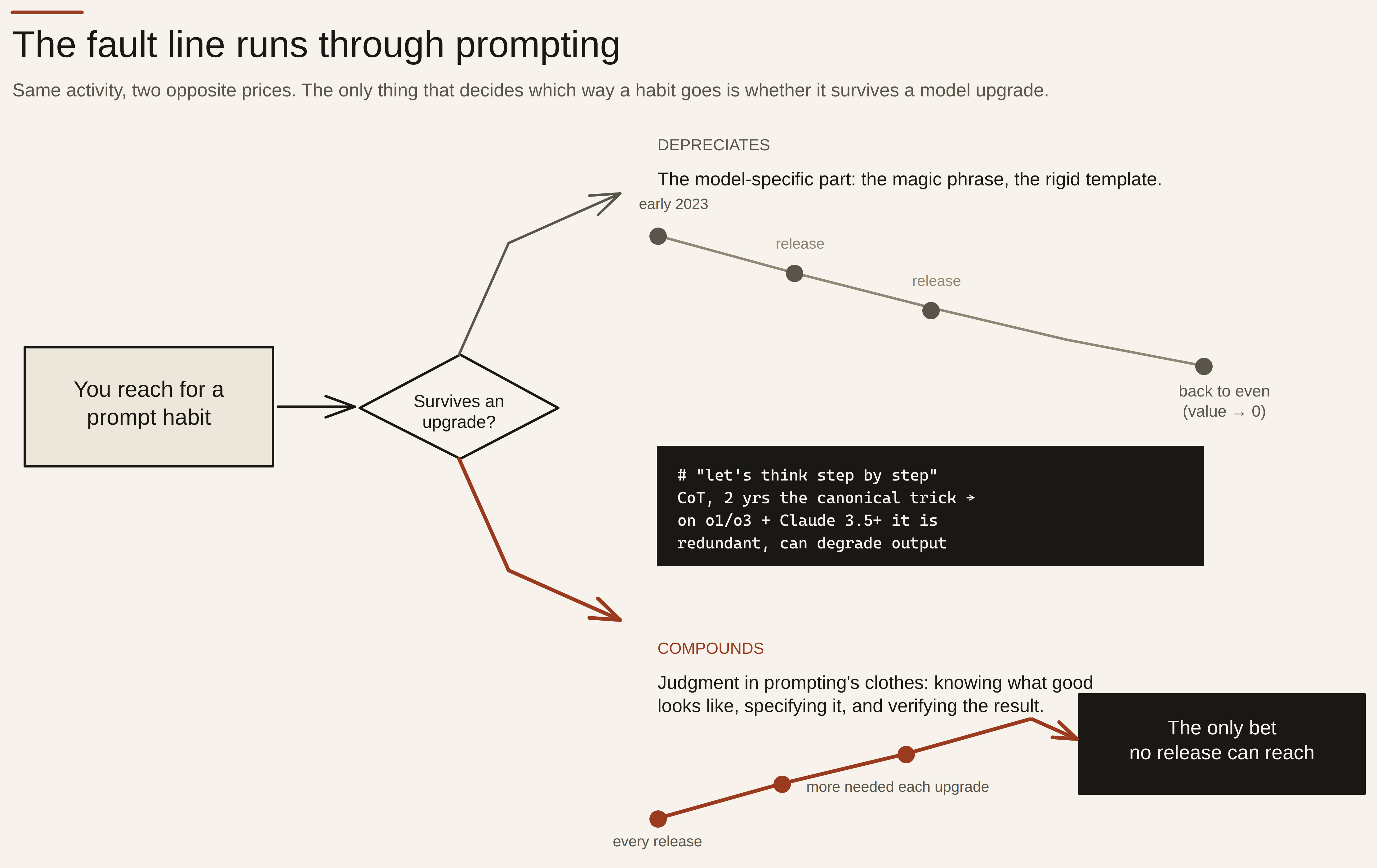
The trick-shaped part of the skill depreciated to zero. The judgment-shaped part got more valuable and more universal at the same time. Same activity, two opposite prices — and the only thing that decided which way a given habit went was whether it survived a model upgrade.
Proof three: the market is already paying for the part that survives
Now follow the money, because this is where the abstract claim turns into your actual career.
The labor market is repricing the same broad skill — “working with code and AI” — in two opposite directions at once. The part that’s typing-on-request is collapsing: a Stanford study found employment for software developers aged 22 to 25 fell about 20% from its late-2022 peak by mid-2025, and Indeed’s Hiring Lab had software-development postings sitting roughly a third below their February-2020 level (The College Investor on the Stanford study; Indeed Hiring Lab data, via Rest of World).
But look at what’s getting more valuable in the same breath. In Stack Overflow’s 2025 developer survey, 84% of developers said they use or plan to use AI tools — and only 3% said they “highly trust” what those tools give back. Their single biggest frustration, named by 66%, was AI output that’s “almost right, but not quite.” And when asked who they’d still turn to in a future full of advanced AI, the number-one answer — 75% — was: a person, “when I don’t trust AI’s answers” (Stack Overflow 2025 Developer Survey).
Read those numbers as a job posting, because that’s what they are. The work that’s growing is catching the almost-right answer. Knowing what good looks like. Specifying the thing precisely. Verifying the output. Being the person other people trust to say “no, that’s subtly wrong, here’s why.” None of that is a magic phrase. None of it expires when the model updates — it gets more needed every time the model gets more confident and stays subtly wrong.
Here’s the picture to hold onto. A prompt trick is cash you stuffed under the mattress in a currency the vendor devalues every release — it looks like savings, and it quietly buys less each month. Judgment is principal. It sits in the part of the work no upgrade can reach, and it keeps earning.
The fault line runs through prompting, not around it
Now the honest complication, because you’ve already spotted it: some of what people call “prompting” clearly does compound. Learning to break a vague problem into clean pieces. Learning to say exactly what you want instead of gesturing at it. Learning to check the output against what you actually needed. Those make you better at the machine and better at the work, and no release deletes them.
Exactly. That’s the point, and it’s the line you have to learn to draw with your eyes closed.
The fault line doesn’t run between “prompting” and “not prompting.” It runs through the middle of prompting, separating two things that wear the same costume:
- The part that depreciates is model-specific: the magic phrase, the jailbreak framing, the rigid template tuned to one model’s quirks, the trick that exists only because today’s model is dumb in a way tomorrow’s won’t be. You’re memorizing a workaround for a temporary flaw. When the flaw gets patched, your workaround is dead weight.
- The part that compounds is judgment wearing prompting’s clothes: deciding what’s worth building, specifying it so clearly a literal machine can’t misread you, decomposing it into checkable pieces, and verifying the result against a standard you hold and the machine doesn’t. That’s not a trick. It’s taste and clear thinking, and it pays off whether you’re directing a model, a junior teammate, or yourself at 2 a.m.
The actual meta-skill is telling these two apart inside the same activity — feeling, when you reach for a prompt habit, whether you’re sharpening your judgment or just patching this month’s model. Get good at that distinction and you stop pouring hours down the depreciating side. That’s the skill the next release can’t touch, because it’s the skill of knowing what the next release will touch.
What to actually bet on
So go back to Naval, sitting there “stupidly talking to the computer,” refusing to optimize his technique. He looks lazy. He’s actually making the most disciplined bet in the room: he’s noticed that the machine improves faster than his technique ever could, so he’s pulled his attention off technique entirely and put it on the things the machine can’t do for him — knowing what’s worth saying, and judging whether what came back is any good.
You don’t have to be Naval to make the same bet. You just have to stop sorting your effort by what feels productive and start sorting it by what survives an upgrade. The next time you catch yourself saving a clever prompt, ask one question: is this a workaround for a flaw the model will fix, or is it a sharper way of thinking I’d keep even if the model were perfect? Keep the second kind. Let the first kind go — the vendor’s going to take it from you anyway, on a schedule you don’t set.
The folder of prompt tricks feels like an asset because collecting feels like progress. But you can’t out-collect a system that deletes your collection every few months. The only bet that compounds is the one pointed at the part of the work no release can reach: your judgment, your taste, your ability to say what you want and to know when the machine got it wrong. That was always the job. The models just made it the only job worth getting good at — and handed everyone who was hoarding hacks a quiet, expensive lesson in what depreciates.
Sources
- 1Naval Ravikant, “A Motorcycle for the Mind,” nav.al — his stated stance that he doesn’t learn prompt tips and tricks, lets the AI adapt to him, and that such tricks expire “in weeks, perhaps months at best.” Primary source (his own words), current.
- 2Fortune — “Experts say there are ‘no technical skills required’ for this A.I. job that pays six figures,” March 31, 2023 — documents the Anthropic “Prompt Engineer and Librarian” role with base salary listed up to $335,000 at the peak of prompt-engineering hype.
- 3Thomas Morgan, “Prompt Engineering Jobs Are Obsolete in 2025 – Here’s Why,” Salesforce Ben, May 1, 2025 — the Indeed search trend (peaked 144/million, plateaued to 20–30/million), Microsoft survey ranking, Jared Spataro’s “you don’t have to have the perfect prompt anymore,” Nationwide reclassifying the role, and the absorption of prompting skill into broader roles.
- 4Vellum — “Chain of Thought Prompting (CoT): Everything you need to know” — reasoning-native models (OpenAI o1/o3, Anthropic Claude 3.5+) include step-by-step reasoning natively; explicit CoT prompting is “largely redundant and may even degrade performance,” referencing 2025 research on the decreasing value of chain-of-thought.
- 5The College Investor — coverage of a Stanford study: software-developer employment for ages 22–25 down ~20% from its late-2022 peak by July 2025.
- 6Rest of World — “AI is wiping out entry-level tech jobs,” 2025 — cites Indeed Hiring Lab data showing software-development postings roughly a third below February-2020 levels.
- 7Stack Overflow 2025 Developer Survey (AI section) — 84% use or plan to use AI tools, only 3% “highly trust” the output, 66% frustrated by output that’s “almost right, but not quite,” and 75% would turn to a person “when I don’t trust AI’s answers.”