
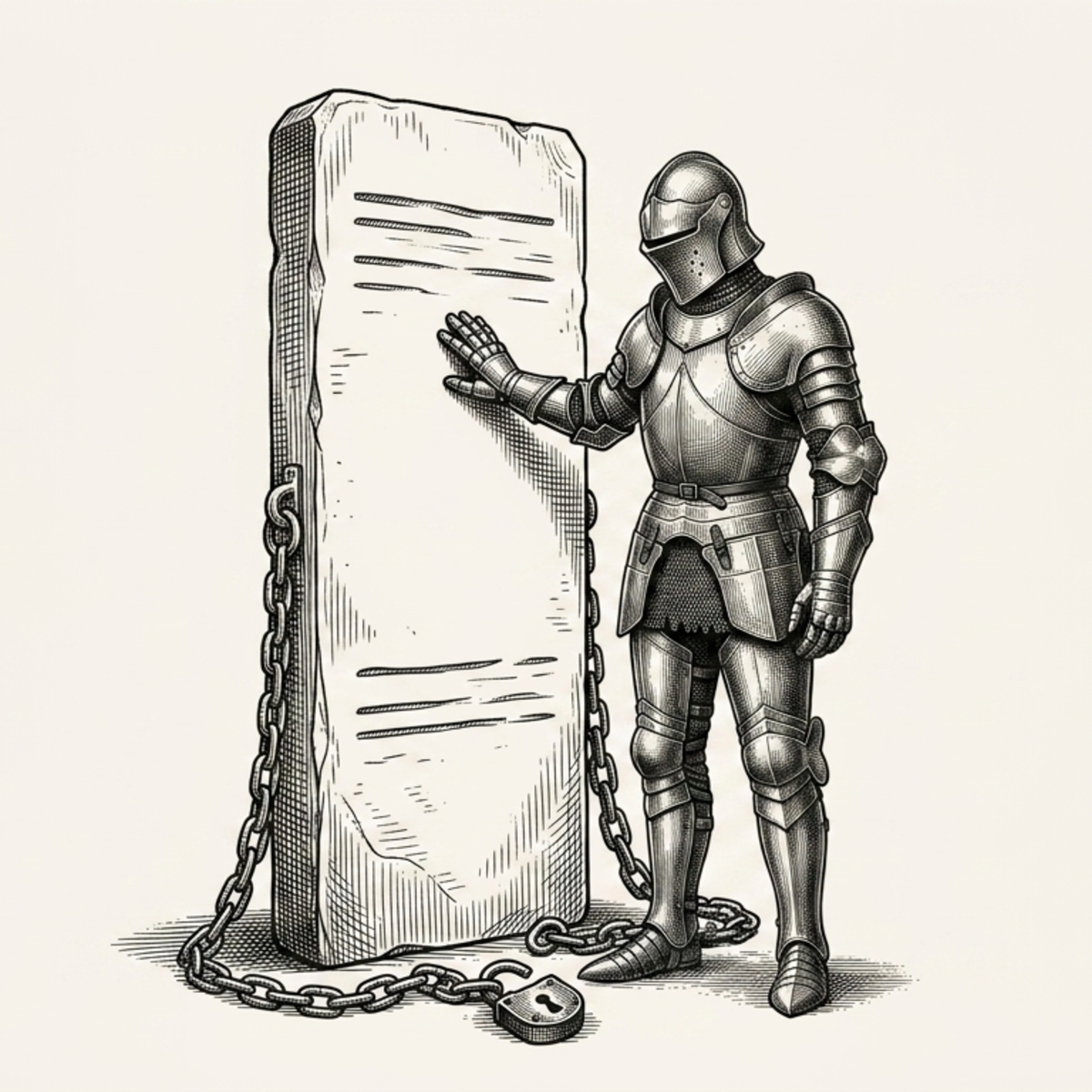
If you’re about to point an AI at a pile of regulations, policies, or rote documentation and have it do the checking, here’s the thing nobody puts on the slide: the time you save is the small win. The real win is that you stop being afraid to change the thing being checked.
That sounds like a stretch, so let me make it concrete and then back it. The pitch you’ve heard — and the pitch you’ll probably make to your own boss — is “we used to spend two days cross-referencing this against the rules; now it takes ten minutes.” True, and worth doing. But the day a re-check costs ten minutes instead of two days, something else shifts that nobody mentions: you start changing the regulated thing more often, because the penalty for touching it just collapsed. The speed is the headline. The willingness to change is the story.
This is for you if you’re betting your career on building useful things next to AI, and you’re eyeing one of these “let the model grind through the boring document work” projects — at your job, or as the thing that gets you the next one. If you’re a compliance officer shopping for a vendor and a buying checklist, this isn’t that piece; this is about why the second-order effect is the part worth building toward.
The win everyone names: the search gets cheap
Start with the part that’s real and easy to sell. Checking work against a body of rules — drug labels against FDA requirements, a design against a certification basis, a contract against a policy — has always been slow, manual, and mostly finding: hunting through hundreds of pages to locate the three clauses that apply, then arguing about whether you met them.
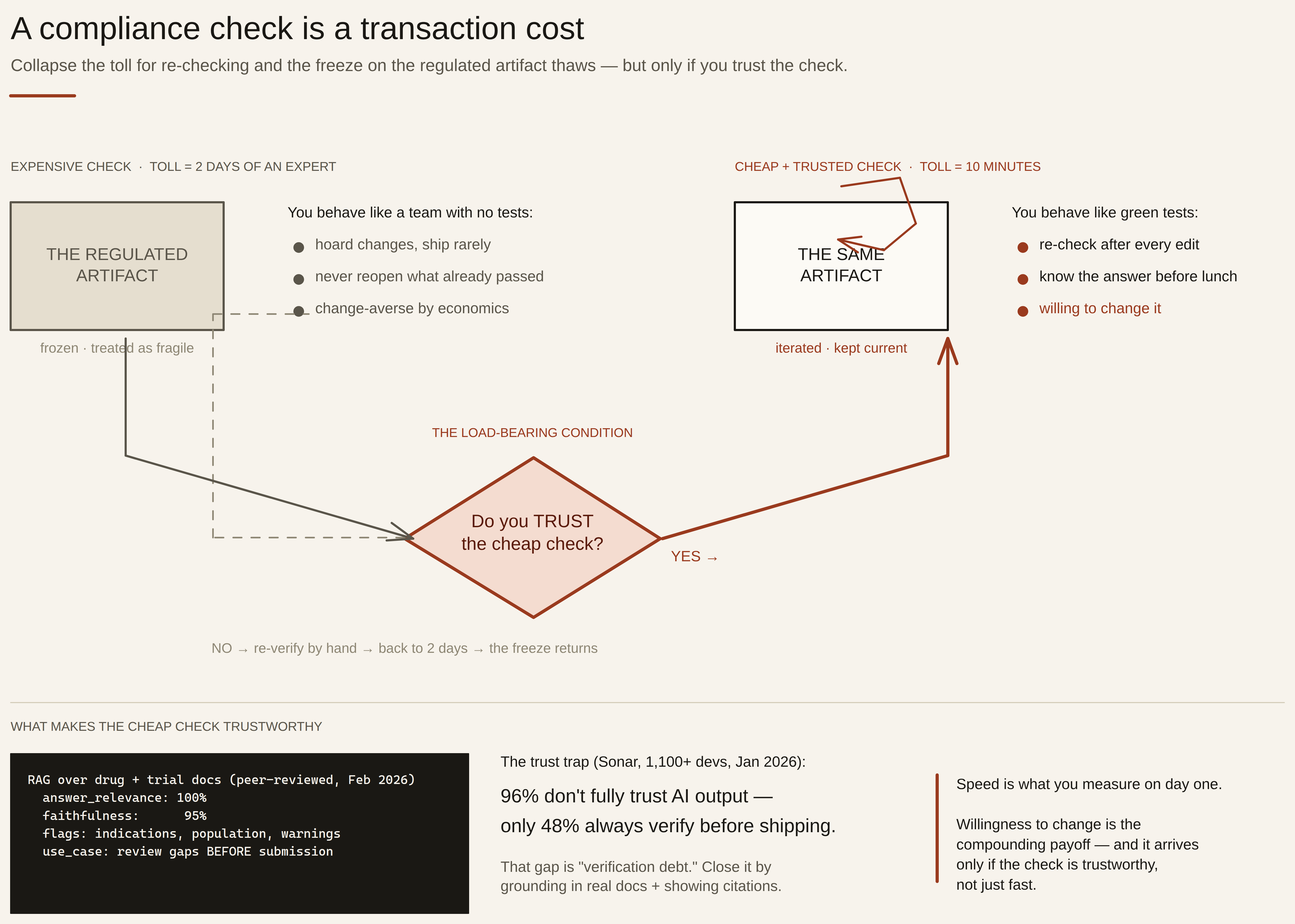
That search is exactly what retrieval-augmented generation is good at. (Retrieval-augmented generation, or RAG, just means the AI looks up the relevant passages from your actual documents before it answers, instead of guessing from memory — so it quotes the real rule, not a plausible-sounding one.) In a peer-reviewed study published in February 2026, researchers built a RAG system to check drug information and clinical-trial protocols against regulatory requirements; it scored 100% on answer relevance and 95% on faithfulness, correctly flagging indications, population restrictions, and warnings for the FDA-approved drugs they tested. Their own conclusion names the use case precisely: such systems “may help sponsors systematically review drug documents for compliance gaps before regulatory submission.”
That word — before — is the whole game, and we’ll come back to it. IBM frames the broader move the same way: grounding generative AI in your own source documents turns a slow manual hunt through regulatory text into a fast, sourced answer. So yes: the check that took days takes minutes. Bank that win. It’s just not the interesting one.
The win almost nobody writes: cheap re-checking makes you brave
Here’s the part that doesn’t make the demo. When checking is expensive, you avoid triggering it. That’s not laziness — it’s economics, and it has a name.
In lean product development, every change carries two costs: the cost of not changing (waiting, stale work, delayed value) and the transaction cost — the overhead you pay every time you make and validate a change. Don Reinertsen’s work on product-development flow shows that the economically right batch size is set by that transaction cost: when validating a change is expensive, you rationally batch up many changes and ship them rarely, because each validation hurts. When validating gets cheap, the math flips — small, frequent changes win. It’s the same reason continuous integration and automated testing changed how software gets built: they drove the cost of re-checking toward zero, and teams went from quarterly releases to many a day.
A compliance check is a transaction cost. It’s the toll you pay to touch the regulated artifact — the design, the label, the policy, the filing. When that toll is two days of an expert’s time, you behave exactly like a team with no automated tests: you hoard changes, you avoid reopening anything that’s already “passed,” you treat the certified version as fragile and basically frozen. You become change-averse — not because you don’t have better ideas, but because the cost of proving you didn’t break compliance is too high to pay casually.
Drop that toll to ten minutes and the freeze thaws. Now you can ask “what if we changed this requirement?” and know the answer before lunch. You re-check after every edit, the way you’d re-run a test suite. The artifact stops being a fragile thing you protect and becomes a thing you iterate. That’s the real shift: not that the check is faster, but that cheap checking makes you willing to change the very thing you used to leave alone.
Aerospace is the cleanest example of how much that fear costs. Boom Supersonic is grinding through FAA type certification for its Overture airliner — a multi-stage “G-1” process of negotiating exactly which airworthiness standards apply and how you’ll prove you meet them. CEO Blake Scholl has been blunt that a chunk of aerospace’s slowness is self-inflicted by ancient tooling — much of the industry’s engineering is still “trapped in Excel spreadsheets and laborious handoffs,” and the edge comes from software-driven practices that let you iterate. When every design tweak means manually re-tracing it through a mountain of regulations, you don’t tweak. Make that re-trace cheap, and suddenly improving the design stops being a compliance event you avoid.
The freeze was never about the rules. It was about the cost of proving you still followed them.
Why this is literally your day job
Here’s why you should care even if you’ll never touch an aircraft or a drug label. Strip “compliance” of its drama and it’s just this: checking an artifact against a fixed body of rote documentation. That shape is everywhere.
- A pull request checked against your team’s coding standards and security policy.
- A vendor contract checked against your procurement rules.
- An internal doc checked against the style guide and the latest product facts.
- An onboarding flow checked against the current legal and privacy requirements.
- Any “does this still match the spec?” question you currently avoid asking because answering it is a slog.
Every one of these is a RAG-over-rote-documentation play, and every one carries the same hidden transaction cost. The reason your team’s design docs drift out of date, the reason nobody updates the runbook, the reason the policy and the practice quietly diverge — it’s rarely that people don’t care. It’s that re-checking is expensive, so the rational move is to leave it alone. Automate the check, and you don’t just save the afternoon. You change what your team is willing to keep current.
The catch: a cheap check is worthless if you can’t trust it
One hard caveat, because the whole second-order win depends on it. The willingness to change only follows if you actually believe the cheap check. The moment you re-verify everything the AI checked by hand, you’re back to two days, and the freeze returns.
And trust is exactly where teams are getting burned right now. Sonar’s State of Code Developer Survey of over 1,100 developers (January 2026) found that 96% don’t fully trust that AI-generated output is correct — yet only 48% always check it before shipping. AWS CTO Werner Vogels calls the gap “verification debt”: you took the speed and skipped the proof. For code that’s risky. For a compliance check, it’s the whole ballgame — a confident, wrong “you’re compliant” is worse than no check at all.
So the load-bearing skill in any of these projects isn’t getting the AI to generate the answer. It’s making the check trustworthy enough to act on: grounding it in the real source documents, showing its citations so a human can spot-check the reasoning instead of redoing it, and measuring how often it’s right before you let it gate anything. The peer-reviewed drug study didn’t just answer — it scored faithfulness and explained each deficiency. That’s the bar. A check you can’t trust gives you the speed and not the courage.
What to actually build toward
If you’re choosing what to build — or what to put on your résumé — here’s the move. Don’t pitch “AI that reads our regulations and saves us time.” Everyone’s pitching that, and it stops at the demo. Pitch the second-order version: an AI check trustworthy enough that we stop being afraid to change the regulated thing — and start keeping it current the way we keep our tests green.
The one thing to remember: speed is what you can measure on day one, but the willingness to change is the compounding payoff — and it only arrives if you spend your effort on the half that’s hard, which is making the check trustworthy, not making it fast. Build the trust, and the courage follows for free.
Sources
- 1Shreyas Waikar, Amruta Gajanan Bhat, Murali Ramanathan, “Retrieval Augmented Generation (RAG) for Evaluating Regulatory Compliance of Drug Information and Clinical Trial Protocols”, CPT: Pharmacometrics & Systems Pharmacology (Wiley), February 19, 2026 — peer-reviewed; 100% answer relevance / 95% faithfulness and the “review for compliance gaps before submission” use case.
- 2IBM — “Enhancing regulatory compliance in the AI age by grounding documents with generative AI” — vendor-neutral explainer on RAG-grounded compliance research.
- 3Innolution — “Agile Documentation and the Economics of Batch Size” — transaction cost as the driver of economically optimal batch size (Reinertsen, The Principles of Product Development Flow).
- 4Aerospace Global News — “Boom Supersonic receives green light for Overture FAA Certification process” — the multi-stage G-1 certification process and Scholl’s comments.
- 5Boom Supersonic FlyBy — “Boom Engineers Love Their Work” — Scholl on legacy aerospace tooling “trapped in Excel spreadsheets” and software-driven iteration.
- 6Sonar — “Sonar Data Reveals Critical ‘Verification Gap’ in AI Coding” — State of Code Developer Survey, January 8, 2026, 1,100+ developers: 96% don’t fully trust AI output, 48% always verify; Werner Vogels’ “verification debt.”