

Here’s the part of the AI story that never makes it onto a slide: for a lot of real work in 2026, you’re the cheap option. The AI sold as your replacement often costs more to run than the salary it was supposed to save.
That’s not a forecast. It’s already happening at the companies furthest out in front. And it turns the usual headline on its head — the machine isn’t quietly underpricing you. For a wide band of real tasks, it’s the expensive hire.
This is for you if you’re betting your career on staying useful next to AI — learning to code, switching fields, or just wondering whether the thing you’re good at still matters. If you’re a finance lead hunting for a playbook to cut your company’s cloud-AI bill, this isn’t that piece.
The short version: the price of AI is falling fast, but the amount of AI a real task uses up is rising faster — so the bill goes up, not down. (AI is billed in tokens — small chunks of text, roughly a few characters each, counted on the way in and the way out.) Which means the skill that holds its value isn’t doing the task. It’s making an expensive tool worth its cost: knowing what to point it at, when not to, and how to prove it actually got the answer right.
The companies furthest ahead hit the wall first
Start with the quote that should have been bigger news. Bryan Catanzaro, a vice president at Nvidia — the company selling most of the chips this entire boom runs on — told Axios in April 2026:
“For my team, the cost of compute is far beyond the costs of the employees.”
Read that twice. The person whose job is to sell you on AI compute is telling you it costs his own team more than their salaries. (Fortune confirmed the title and wording.)
It isn’t just talk. Microsoft began canceling most of its direct Claude Code licenses — Claude Code is an AI coding assistant — about six months after rolling it out, moving its engineers to GitHub Copilot’s command-line tool instead. The reason wasn’t that the tool was bad. It was that the scale at which engineers used it kept driving the cost up. Uber went further: it burned through its entire 2026 budget for AI coding tools in four months, even after running internal leaderboards to push people to use them — and then capped spending at around $1,500 per engineer per month.
These are not cost-shy companies. They’re the early adopters with the deepest pockets, and they’re the ones hitting the wall first.
Why the bill goes up while the price goes down
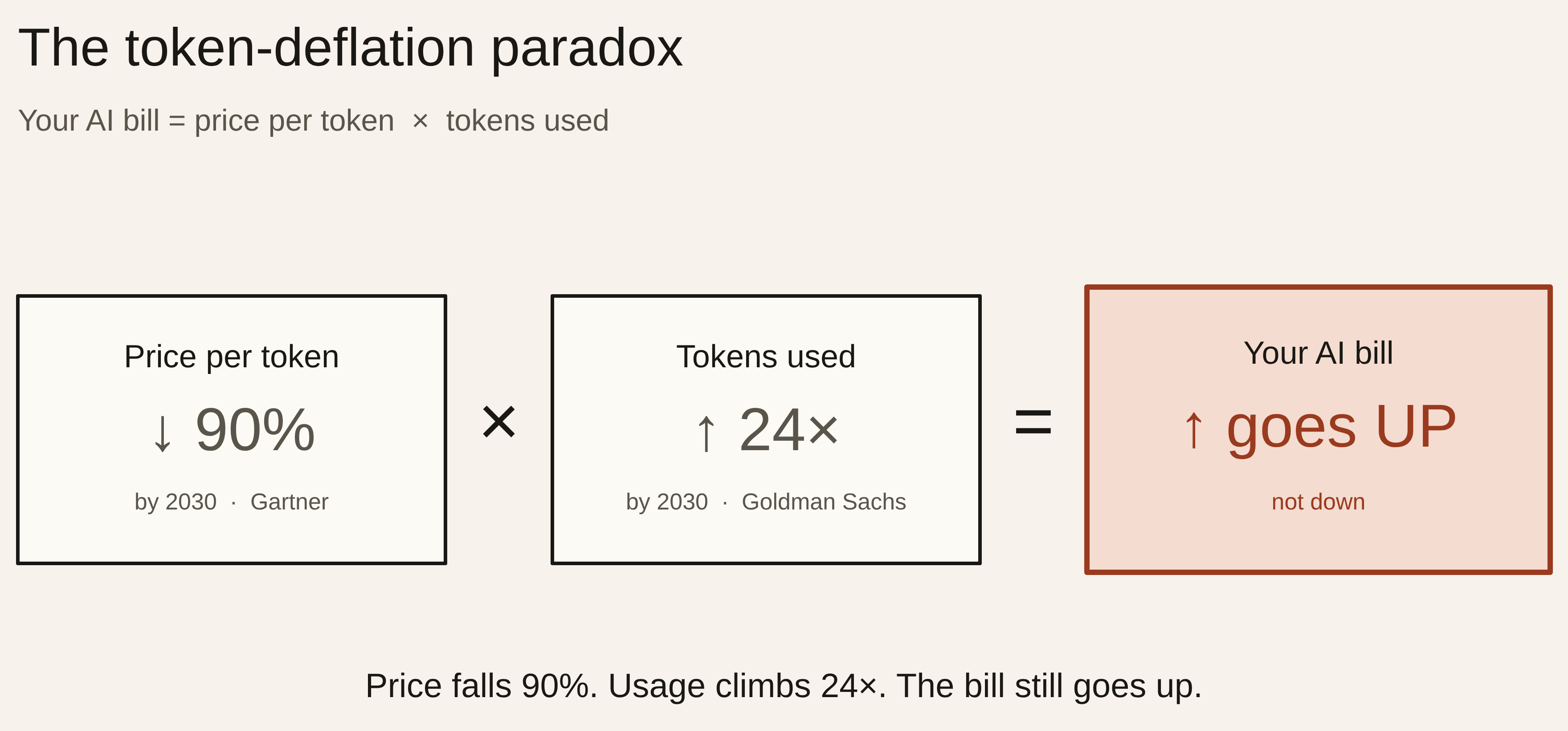
Here’s the confusing part, and the heart of it. The price of AI is genuinely crashing. Gartner forecasts that by 2030, running a query on a top-end model will cost the AI providers over 90% less than it does in 2025. So how does the bill go up?
Because your bill isn’t the price of one token. It’s the price of a token times how many tokens you burn — and the second number is the one exploding. Goldman Sachs Research forecasts that total token use will rise about 24 times by 2030, to roughly 120 quadrillion tokens a month. When the price of a thing drops 90% but you buy 24 times more of it, you spend more, not less.
Two more catches hide in there. The providers aren’t passing the full savings on — the cheap tokens are the commodity ones, while strong reasoning stays expensive. As Gartner’s Will Sommer put it, companies “should not confuse the deflation of commodity tokens with the democratization of frontier reasoning.” Translation: the bargain-bin tokens get cheaper; the ones that actually do hard thinking don’t.
What’s expensive is autonomy, not answers
So what’s burning all those tokens? Autonomy.
A single answer from a chatbot is cheap — you ask, it replies, you’re done. An agent is a different thing: it’s an AI that works a task in a loop — reading, trying something, checking its own output, retrying, calling other tools — without stopping to ask you between each step. Every one of those steps spends tokens. Gartner estimates an agentic task burns 5 to 30 times the tokens of a single chatbot question.
Now scale that picture up. Nvidia’s CEO Jensen Huang describes a near future where the company’s 75,000 employees work alongside 7.5 million AI agents — roughly 100 agents for every person. A hundred tireless workers each sounds like a steal, right up until you remember every one is metered, and each runs 5-to-30× hotter than a chatbot. The expensive part was never the answer. It’s the autonomy — the looping, retrying, self-checking machine running deep and unattended.
What this means for your career bet
This is where it stops being a corporate cost story and becomes yours. If the expensive part of AI is letting it run unattended, then the valuable person is the one who keeps it from having to.
That’s a specific skill, and it isn’t typing. It’s three things:
- Judgment about what to point it at — which tasks are worth the token bill, and which you should just do yourself, or not at all.
- Restraint about when not to use it — knowing when a five-minute human answer beats a thirty-times-the-tokens agent run you’d have to check anyway.
- Verification that it actually worked — being the person who can tell whether the output is right, because a confident wrong answer, produced at scale, is the most expensive thing in the building.
Notice what those three have in common: none of them is the part AI is cheap at. They’re the judgment around the work, not the work itself. Right now, a person with that judgment is both better and cheaper than an agent left to run on its own. Good-and-cheap is a real position to hold — and it’s the one you can actually train for.
The honest caveat
One caveat, because respecting you means not overselling. Prices really are falling. For some tasks the math has already flipped to the machine, and for more it will. This is a window, not a law of nature.
But that’s the argument for walking through it, not standing still. The window is open precisely because the tools are still expensive and clumsy enough that human judgment pays for itself. Use it to become the person who’s worth keeping on either side of the flip — the one who knows what to build, when to spend, and how to tell whether it worked.
The question was never whether AI can do your task. It’s whether doing it your way costs less than doing it the machine’s way. Right now — far more often than the headlines admit — the answer is you.
Sources
- 1Axios — “AI can cost more than human workers now” (Apr 26, 2026) — original Catanzaro quote.
- 2Fortune — Nvidia executive on AI costing more than employees (Apr 28, 2026); confirms Catanzaro’s title and wording.
- 3Fortune — “Microsoft reports are exposing AI’s real cost problem” (May 22, 2026) — Microsoft Claude Code reversal; the token-deflation mechanism.
- 4Fortune — Uber burned its 2026 AI budget in four months (May 26, 2026).
- 5TechCrunch — Uber caps employee AI spending (Jun 2, 2026); the ~$1,500/month cap.
- 6Gartner — inference cost to drop 90%+ by 2030 (Mar 25, 2026); the provider-cost forecast, the 5–30× agentic multiplier, and Will Sommer’s quote.
- 7CIO Dive — coverage of the Gartner forecast (Mar 2026); the 5–30× per-task figure.
- 8PYMNTS — Goldman Sachs on AI agents and token usage (May 24, 2026); the 24× / 120-quadrillion-tokens forecast (Goldman analyst Jim Schneider).
- 9Fortune — Jensen Huang on 75,000 employees and 7.5M agents (Mar 19, 2026); the ~100-to-1 agent-to-employee ratio.
Note: forecasts from Gartner and Goldman Sachs are projections to 2030, not measured facts — read them as direction and magnitude, not precision.