Here’s the math everyone does in their head, and it always lands the same way.
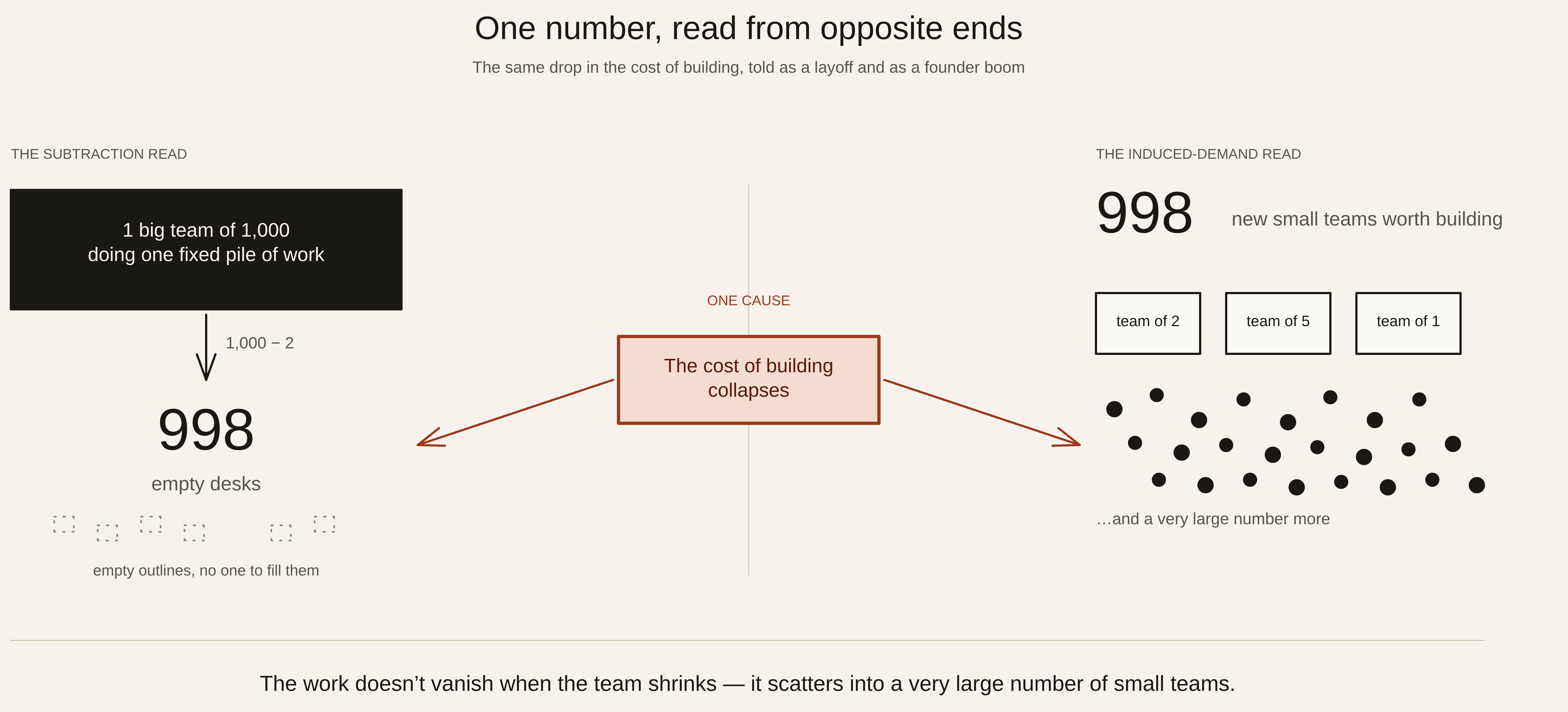
A thing that used to take a thousand people now takes two. So a thousand minus two is nine hundred and ninety-eight, and nine hundred and ninety-eight is the number of people who lose their seat. You can run this on anything. A jet engine. A film. A piece of software. A marketing department. Pick the team, divide by the new tool, subtract — and out the other end comes a layoff. The arithmetic feels airtight, because it is arithmetic. Subtraction doesn’t lie.
This is the reasoning behind almost every “AI will eliminate X million jobs” headline you’ve scrolled past. It treats the work as a fixed pile — a set amount of building that has to get done — and AI as a faster shovel. Same pile, fewer shovels needed, so the spare workers go home. It’s the read your manager has at the back of their mind, the read a worried parent has when their kid says they’re learning to code, the read you probably have yourself on the bad days. It is the most natural way to think about a tool that does more of your job every month.
If you’re trying to decide whether the bet you’re making on your own career still pays — whether to start the thing, learn the skill, switch into the field, or just brace for the cut — this is for you. Because the subtraction is real, but it’s only half the equation. And the people who only do the subtraction are reading their own future wrong.
The pile of work was never fixed
The “fixed pile” idea is so old that economists gave it a name almost two centuries ago, mostly so they could keep telling people they were wrong about it. It’s the lump of labour fallacy: the belief that there’s a set amount of work in an economy, so anything that lets the same work get done with fewer people — a machine, a shorter workweek, an immigrant, a piece of software — must leave someone with nothing to do. It shows up every time a new tool arrives, and it has been wrong every time, for the same reason: the amount of work an economy wants done is not a fixed number. It moves. Usually it moves up.
The reason it’s called a fallacy and not a debate is that we have the receipts. Take the spreadsheet — the closest historical twin to what’s happening now, because it automated the exact thing it was supposed to automate. VisiCalc and then Excel took the arithmetic out of accounting, the part a room full of clerks used to do by hand. By the lump-of-labour math, accountants were finished.
They weren’t. The economist Tim Harford pulled the numbers: in 1980, around when VisiCalc took off, the US Bureau of Labor Statistics counted about 339,000 accountants and accounting clerks. By 2022 it counted 1.4 million accountants and auditors. The figures aren’t perfectly comparable across four decades of reclassification — Harford says so himself — but the direction is not subtle. The tool that was supposed to subtract accountants multiplied them. What got cheap wasn’t accountants; it was arithmetic. And once arithmetic was nearly free, people wanted a lot more of the thing arithmetic was an input to — financial models, scenarios, budgets, forecasts — so they hired more of the people who could think in numbers, not fewer.
That’s the part the subtraction misses. It assumes the output — the jet engine, the report, the app — is a fixed thing you now get for less. It almost never is. When the cost of making something falls far enough, you don’t buy the same amount of it more cheaply. You start making things that were never worth making before.
The cheaper it gets, the more of it you do
There’s a name for this too, and it’s even better, because it was discovered by a man trying to prove the opposite.
In 1865, William Stanley Jevons noticed that as steam engines got more efficient — as each ton of coal did more work — Britain’s coal consumption didn’t fall. It rose. A lot. Cheaper power didn’t mean Britain needed less coal to do the same jobs; it meant power got cheap enough to be worth using for a thousand jobs nobody had bothered powering before. The efficiency gain didn’t shrink demand. It uncorked it. We call it the Jevons paradox: make a unit of something cheaper, and if there’s latent demand waiting, total consumption goes up, not down.
The same thing is true of building. Most of the things that would be worth making never get made — not because nobody wants them, but because at current prices they’re not worth the labour. The bespoke internal tool for a forty-person company. The piece of software that serves three thousand people instead of three million. The strange specialized product for a niche too small to fund a team. There’s an enormous backlog of things that sit just past the line of “worth building,” and they stay unbuilt because building costs what it costs.
Drop the cost of building, and that line moves. Things that were just past it cross over. And there are far more things just past the line than there are inside it — that’s the shape of any long tail. So when two people can now build what took a thousand, the result isn’t one engine for the price of two salaries and a hangar full of pink slips. It’s that the same two people, freed from the cost of the first engine, can now go build the second, and the fortieth, and the four-hundredth — engines that no one could justify designing when each one needed a thousand people and a year. The doomer sees nine hundred and ninety-eight empty desks. What actually fills the room is nine hundred and ninety-eight new engines that were never worth building before, each one wanted by someone who could never previously afford to commission it.
This is the turn, and it’s worth saying flatly because the consensus version of it is mush. The optimist’s line — “don’t worry, AI will create new jobs too” — is true and almost useless, because it sounds like a consolation prize handed to you on the way out. The sharper version is this: the same drop in cost that lets two people replace a thousand is exactly the thing that makes a thousand new two-person projects worth attempting. The layoff math and the founder boom are not two competing stories about AI. They are one number, read from opposite ends. You cannot have the cheapness that fires people without the cheapness that lets a far larger number of much smaller teams exist.
The layoff math and the founder boom are not two competing stories about AI. They are one number, read from opposite ends.
The small teams are already here — and some of them barely exist
If this were only a theory, you’d be right to be skeptical of it. But the small teams aren’t a forecast. They’re a balance sheet.
Midjourney reached roughly $200 million in annual recurring revenue with fewer than a hundred employees and not a single dollar of venture capital — a company CB Insights argued you could reasonably value around $10 billion, run by a team smaller than one mid-sized company’s marketing department. Anysphere, the maker of the coding tool Cursor, reportedly crossed $100 million in revenue with under 30 people, then scaled to around $2 billion in annual recurring revenue with roughly 300 — among the fastest software companies in history to reach that mark. Bloomberg, not a hype sheet, called it the “tiny team” era of Silicon Valley in mid-2025: a wave of companies producing revenue per head five to ten times the old software benchmark, where the trophy stopped being a billion-dollar valuation and became a billion in revenue split across as few people as possible.
And the ceiling on “small” keeps dropping. Sam Altman has said for two years now that he and a group chat of other tech CEOs run a betting pool on the year the first one-person billion-dollar company appears — a thing he flatly called impossible before AI and now treats as a question of when. Take that as a CEO’s marketing if you like. You don’t have to believe the one-person billion-dollar company to notice the trend it sits at the end of, because the trend was running before the AI even arrived.
Instagram had 13 employees when Facebook bought it for about a billion dollars in 2012. WhatsApp had 55 when Facebook paid $19 billion for it two years later. No large language model touched either of those — they rode the previous cost collapse, the one cloud computing and the App Store delivered, where suddenly a handful of people could ship software to a billion phones without owning a server or asking a single gatekeeper for permission. AI is the next turn of the same crank. Each time the cost of building falls, the number of people it takes to reach a given scale falls with it — and the number of teams that can clear the bar at all goes up.
So the swarm of small teams isn’t the optimistic scenario. It’s the trend line, already drawn, with AI bending it steeper. The honest question was never whether the small teams are coming. They’re here. The honest question is who they’re good news for — and that’s where the cheerful version of this argument quietly cheats.
The part the optimists skip: the swarm doesn’t rehire you in place
Here’s the line the founder-boom crowd doesn’t like to say out loud, so this piece will say it: the swarm of small teams is real, and it does not put the laid-off engineer back in the same chair at a higher wage. Not quickly, and often not at all for that specific person.
The economics on this is not soft. Daron Acemoglu and Pascual Restrepo, who have done the careful work on how automation actually moves through a labour market, describe a tug-of-war between two forces: a displacement effect, where machines take over tasks people used to do, and a reinstatement effect, where new tasks and new work get created around the technology. The optimistic history — work gets automated, new work appears, employment grows — is the reinstatement effect winning over time. But their finding is not that this is automatic or free. Reinstatement happens partially, and slowly, and somewhere else. The new tasks don’t show up in the same firm, the same town, or the same skill set as the ones that were displaced. And the workers caught in the gap pay for it: decades of research on displaced workers, going back to the foundational studies, find large and persistent earnings losses that don’t fully recover even years later.
Translate that out of the journals. “The economy creates more work than it destroys” can be completely true at the same time as “the 38-year-old whose job was the first thing automated spends three hard years and never earns what they did before.” Both are true. The aggregate is kind; the transition is brutal; and you live in the transition, not in the aggregate. Telling a displaced person that net employment will be fine is like telling someone standing in the rain that the regional average is dry.
The aggregate is kind; the transition is brutal; and you live in the transition, not in the aggregate.
You can already see the gap opening in one number that every optimistic AI take should be forced to look at. US software-development job postings on Indeed sat at about 65% of their January 2020 level in early 2025 — a five-year low, down roughly a third, even as the tools to write software got dramatically better and a large majority of engineers started using AI to write code. That’s the displacement effect in plain sight. The typing-code-on-request job, the bottom rung where you sat and implemented a clearly-specified ticket, genuinely thinned out. If your plan was to be hired to do that, the subtraction came for you, exactly as advertised. The lump-of-labour fallacy is a fallacy about the whole economy over time. It is no comfort at all about your job this year.
So the founder boom is not a free pass, and anyone selling it as one is selling you the aggregate while you live in the transition. The honest version of the optimistic case isn’t “relax, it works out.” It’s narrower and more demanding than that, and it changes what you should actually do.
What the swarm rewards is starting one
Put the two halves together. The cost of building is collapsing. That collapse is destroying a particular kind of job — the seat where you wait to be told what to build and then build exactly that — and the same collapse is making a vast number of small, weird, previously-unfundable things worth building. The work doesn’t vanish. It scatters. It moves out of large fixed teams that needed a thousand people, and into a very large number of small ones that need two, or five, or fifty. The economy as a whole is going to be fine. The question that actually decides your outcome is which side of that scattering you’re standing on.
And the scattering rewards a specific posture. It rewards the person who can decide what to build and prove it works — the judgment half of the job, the half AI hasn’t taken — over the person who can only execute a spec someone else wrote. It rewards the person who starts a small team, or joins one early, over the person waiting for a big team to post the kind of opening that’s getting rarer. It rewards what Naval Ravikant calls permissionless leverage: “Code and media are permissionless leverage… You can create software and media that works for you while you sleep.” You don’t need anyone’s sign-off to write the code or ship the thing. And in a world where the cost of building is the bottleneck that’s falling away, the people who don’t need permission to build are the ones the moment is quietly handing the keys to.
This is not a pep talk and it’s not “just start a startup, bro.” Most people aren’t going to found a billion-dollar company with a laptop, and the takeaway isn’t that they should try. The takeaway is about where to point yourself, whatever the scale:
- Get on the judgment side of the line. The work that’s drying up is “implement this exactly.” The work that’s multiplying is “figure out what’s worth building and confirm the machine actually built it right.” Treat the second as the skill. It’s the same craft you already have, repriced — and it’s the half that’s going up.
- Aim at the small team, not the big seat. The thing getting rarer is the large org with a stable rung to climb. The thing getting more common is the team of five doing what used to take five hundred. Going where the work is going beats competing for the seats it’s leaving.
- Build one real thing without asking. The permission-free tools only pay off if you actually use them. The person who has shipped one small, working thing — a tool, a product, a site that does a job — is reading the future correctly with their hands, not just their head. You don’t need a company. You need proof you can decide what to build and make it real.
None of that requires believing AI is magic, and none of it requires pretending the transition is gentle. It just requires reading the whole equation instead of half of it.
Back to the two builders and the hangar
So come back to the two people and the jet engine.
The subtraction says: a thousand became two, so nine hundred and ninety-eight desks are empty. And on the day of the layoff, in that specific building, the subtraction is not wrong — those desks really did empty, and the people who sat at them are owed honesty about how hard the next stretch will be, not a slogan about net job creation.
But walk out of that one building and look at the field. The same fall in cost that emptied those desks is the thing letting a different two people, somewhere else, fill a hangar with engines that no one could afford to design when each one took a thousand. And then another two. And another. The work didn’t disappear when the team shrank. It broke into pieces small enough that far more people can now own one — if they’re standing on the side of the line where the work is gathering, not the side it’s leaving.
The future of work this points to isn’t a handful of giant companies running on near-empty floors, and it isn’t a graveyard of deleted jobs. It’s a very large number of small teams — more of them than there have ever been, most of them tiny, many of them not yet started. The only real question the equation leaves you is whether you’re going to wait for one of them to post a job, or go be one of the two people in the hangar.
Sources
- 1Lump of labour fallacy. Wikipedia — Lump of labour fallacy. Definition and history of the fixed-amount-of-work fallacy; current, uncontested as a named concept. See also the St. Louis Fed’s explainer (Jan 2021).
- 2Jevons paradox / induced demand. Wikipedia — Jevons paradox; origin in William Stanley Jevons, The Coal Question (1865). The canonical statement that efficiency gains can raise, not lower, total consumption.
- 3Spreadsheet / accountant numbers. Tim Harford, “What the birth of the spreadsheet teaches us about generative AI” (March 2024), citing US Bureau of Labor Statistics: ~339,000 accountants and accounting clerks in 1980 vs. 1.4 million accountants and auditors in 2022. Harford notes the figures are not directly comparable across the period.
- 4Midjourney. CB Insights, “With $200M in revenue, Midjourney could be worth $10B” (Oct 31, 2023): ~$200M ARR, fewer than 100 employees, no venture capital raised, ~$10B implied valuation.
- 5Anysphere / Cursor. andrew.ooo, “How Cursor Became the Fastest B2B Company to $1B ARR with Just 300 Employees” (2026): ~$2B ARR with roughly 300 employees, over $100M revenue earlier with under 30 people. Trade reporting; figures as reported, not audited.
- 6“Tiny team” era. Bloomberg, “AI Is Ushering in the ‘Tiny Team’ Era in Silicon Valley” (June 20, 2025): revenue per employee five to ten times old SaaS benchmarks.
- 7One-person billion-dollar company. Fortune, “Sam Altman wants AI to create a one-person unicorn with a billion-dollar valuation” (Feb 2024); the betting-pool quote, from Altman’s conversation with Alexis Ohanian. Also covered by TechCrunch.
- 8Instagram (13 employees) and WhatsApp (55 employees). NPR, “Facebook Will Buy WhatsApp Message Service For $19 Billion” (Feb 2014); The Conversation, “WhatsApp bought for $19 billion — what do its employees get?” (55 employees); Instagram’s 13-employee headcount at its ~$1B acquisition is widely reported (e.g. Time).
- 9Automation: displacement vs. reinstatement. Acemoglu & Restrepo, “Artificial Intelligence, Automation and Work” (NBER, 2018) and “Automation and New Tasks” (Journal of Economic Perspectives, 2019): reinstatement is partial and slow, and displaced workers face large, persistent earnings losses.
- 10Software-developer job postings. The Pragmatic Engineer, “Software engineering job openings hit five-year low?” (Feb 2025), drawing on the FRED Indeed software-development postings series: ~65% of the January 2020 level in early 2025.
- 11Permissionless leverage. Naval Ravikant, “Product and Media Are the New Leverage”: “Code and media are permissionless leverage.”